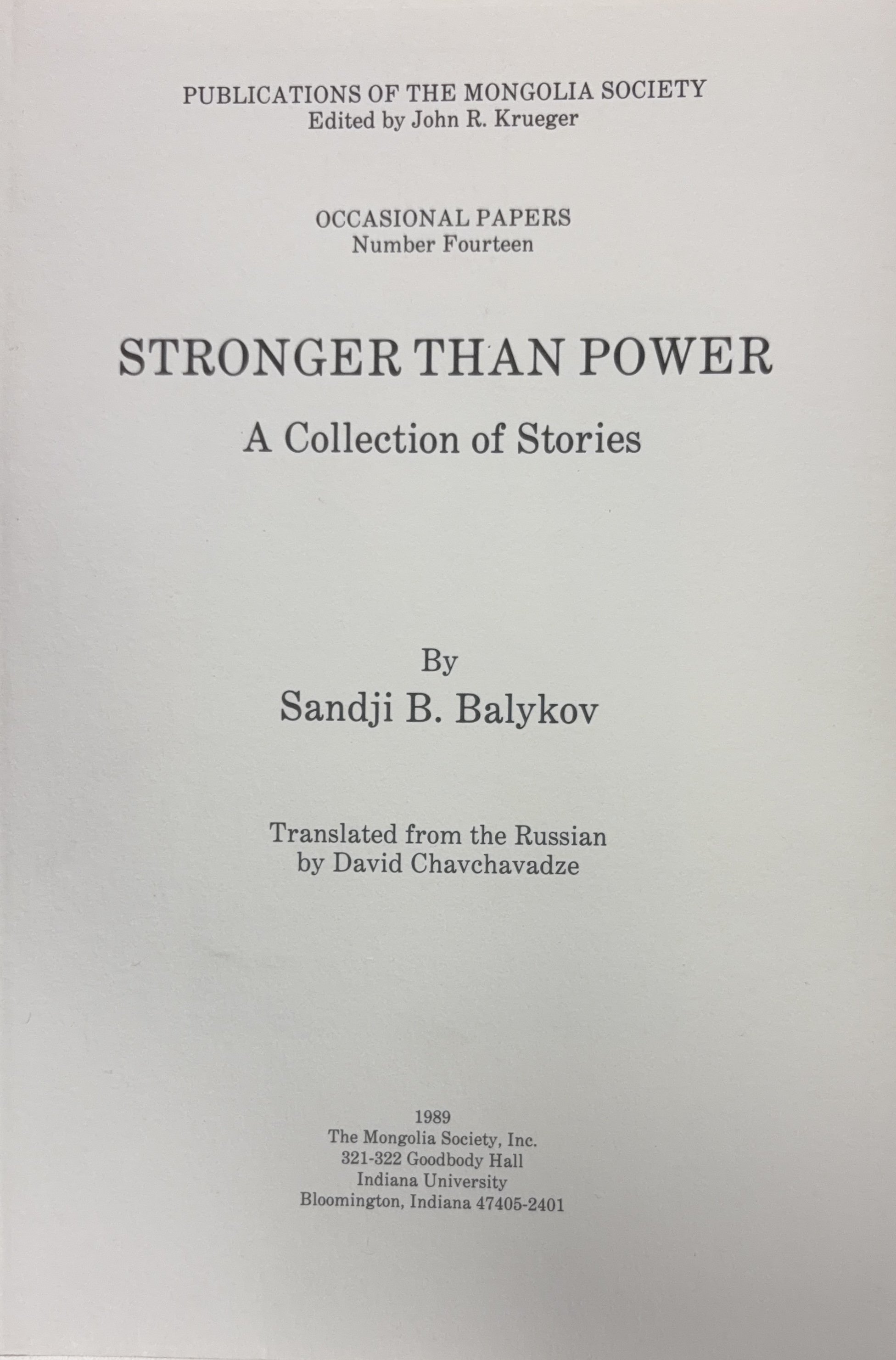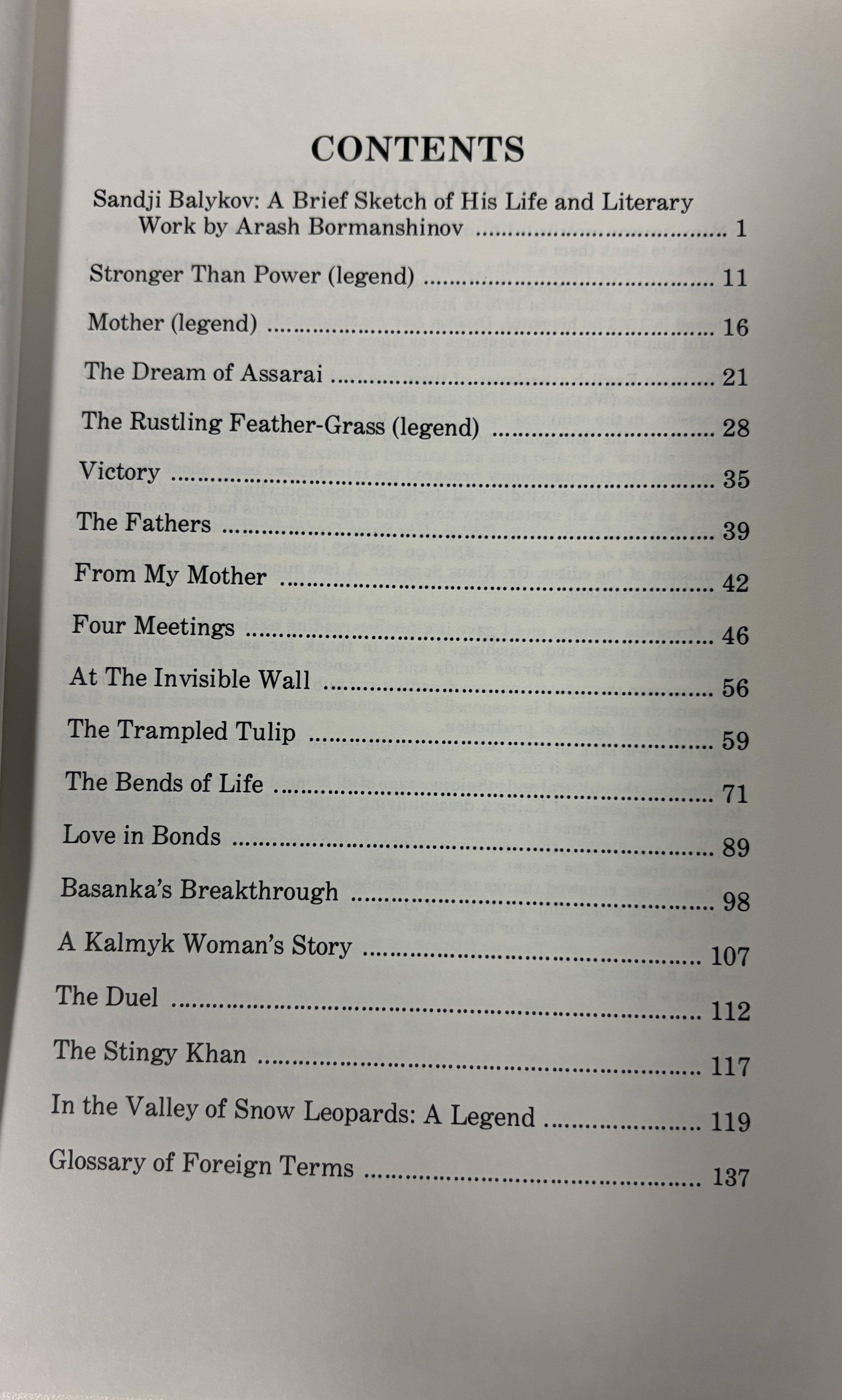
Issue Nine (Spring, 1986). Amur, Monggol-un tobci teüke. The first volume of theMongolian history projects. Ulan Bator, 1934. Mongolian text with an introduction in English by Robert G. Service. 446 pages. $40.00

Occasional Paper Number Nineteen (Winter , 1996).
Dr . Hans S. Kaarsberg, Among the Kalmyks of the Steppes on Horseback and by Troika; A Journey Made in 1890 (The Travelogue and Ethnography of a Danish Physician in Russia).
Translated from the Danish.
124 ppgs.
$18.
Occasional Paper Number Eighteen (Winter , 1996).
Adventures of Michailow, a Russian Captive; among the Kalmucs, Kirghiz and Kiwenses, written by himself.
London, 1822. Enlarged reproduction of the rare original, with editor's remarks about the predecessor volume in German.
46 pages.
$15.00
Occasional Paper Number Sixteen (Spring, 1995).
Mongol Oral Narratives: Gods, Tricksters, Heroes & Horses.
One hundred Mongolian folktales from Inner Mongolia. Topics include origins, monsters, lamas, humor, Gesar Khan, and fables.
Translated by Nassenbayer, et al .
Illustrated by Danzan, edited by Kevin Stuart.
83 pages.
$18.00
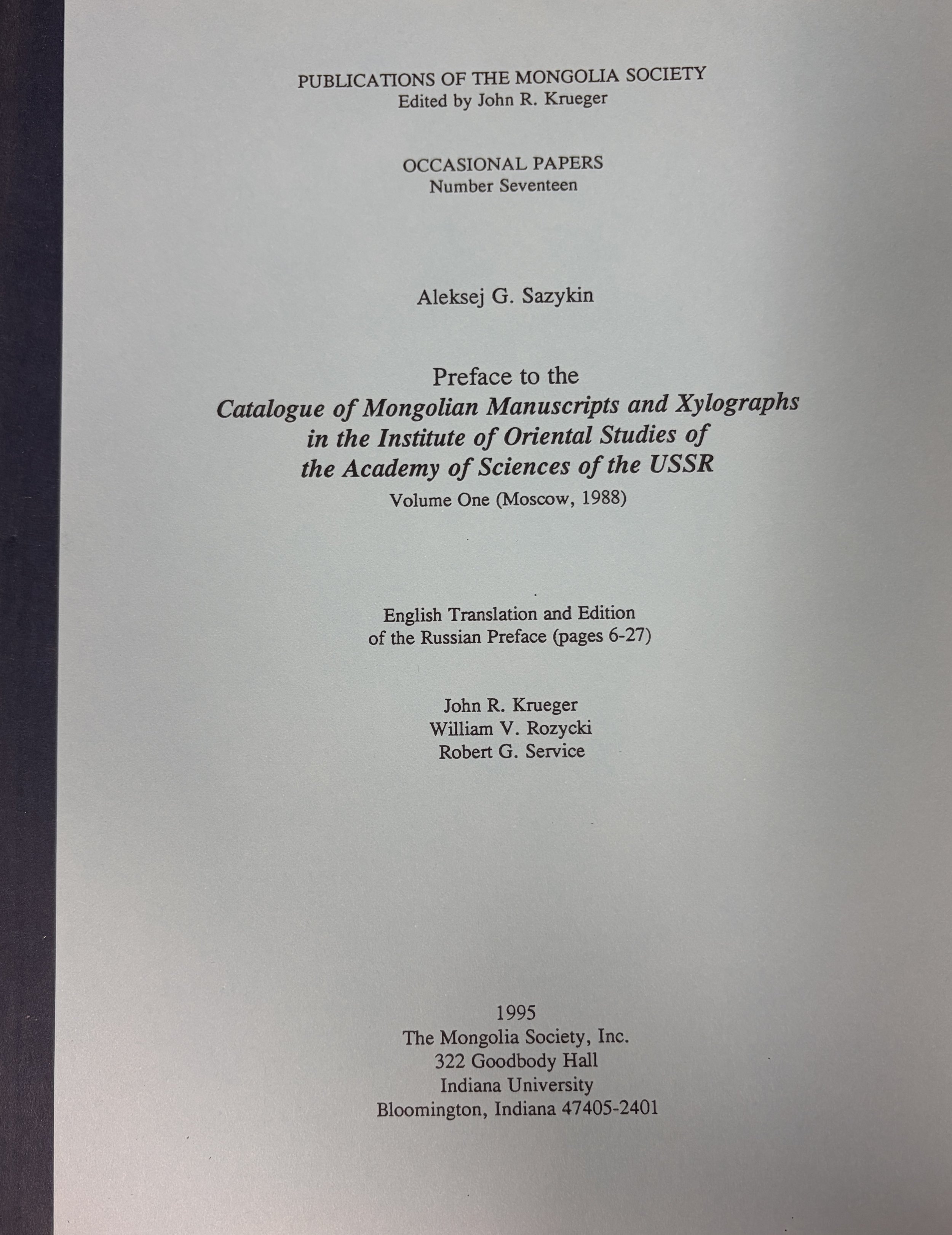
Occasional Paper Number Seventeen (Summer , 1995).
Aleksej G. Sazykin, Preface to the Catalogue of Mongolian Manuscripts and Xylographs in the Institute of Oriental Studies of the Academy of Sciences of the USSR.
English translation and edition of the Russian preface by John R. Krueger, William V. Rozycki, and Robert G. Service.
This Catalogue surveys the entire development of Mongolica in Russia. 30 pages.
$12.00
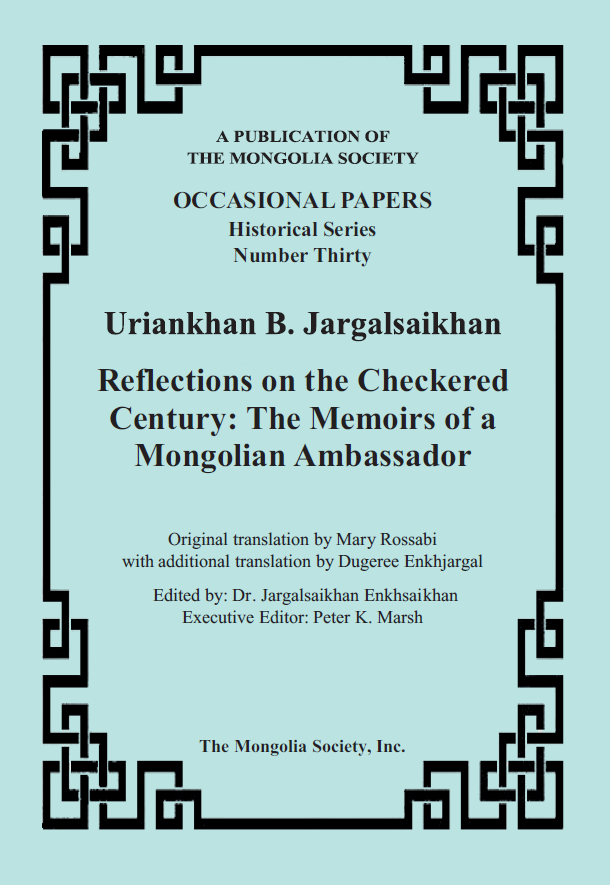
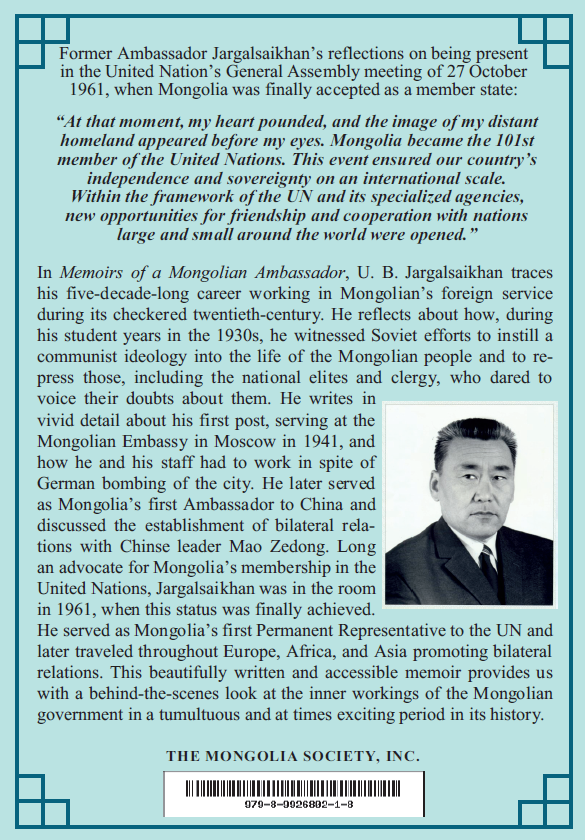
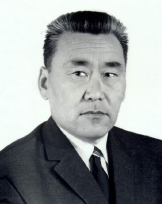
In Memoirs of a Mongolian Ambassador, U. B. Jargalsaikhan traces his five-decade-long career working in Mongolian’s foreign service during the checkered twentieth century. He reflects about how, during his student years in the 1930s, he witnessed Soviet efforts to instill a communist ideology into the life of the Mongolian people and to repress those, including the national elites and clergy, who dared to voice their doubts about them.
He writes in vivid detail about his first post, serving at the Mongolian Embassy in Moscow in 1941, and how he and his staff had to work in spite of German bombing of the city. He later served as Mongolia’s first Ambassador to China and discussed the establishment of bilateral relations with Chinese leader Mao Zedong.
Long an advocate for Mongolia’s membership in the United Nations, Jargalsaikhan was in the room in 1961, when this status was finally achieved. He served as Mongolia’s first Permanent Representative to the UN and later traveled throughout Europe, Africa, and Asia promoting bilateral relations.
This beautifully written and accessible memoir provides us with a behind-the-scenes look at the inner workings of the Mongolian government in a tumultuous and at times exciting period in its history.
Memoirs costs $38.00, plus postage, until November 1, 2026. After then, the cost will be $50.00, plus postage. (U.S. postage $5.50, overseas postage varies by destination.)

We ask those who attend or present at the 2026 Mongolia Society Annual Meeting to pay a fee to help defray the cost of organizing it.
Regular attendance fee for Non-Mongolia Society members to attend in-person is $140 (after September 1, 2026).

A Note from the Editor
Articles
The History of the Yuan, Chapter 1, edited & Translated by Christopher P. Atwood
Mongolia’s View on Sino-Russian Relations, by Nyamdoljin Adiya
Changkya Qutuγtu Rol-pa’i rdo-rje’s Translation Strategy: Theory into Practice, by Sainbileg Byambadorj
Review Article
Languages of Ancient Southern Mongolia and North China: A Historical-Comparative Study of the Serbi or Xianbei Branch of the Serbi-Mongolic Language, by Andrew Shimunek; Review by Yasunori Takeuchi
Book Reviews
Historical Dictionary of the Mongol World Empire, by Paul D. Buell and Francesca Fiaschetti; Review by Morris Rossabi
A World Trimmed with Fur: Wild Things, Pristine Places, and the Natural Fringes of Qing Rule, by Jonathan Schlesinger; Review by Johan Elverskog
The Lama Question: Violence, Sovereignty, and Exception in Early Socialist Mongolia, by Christopher Kaplonski; Review by Brian Baumann
Governing Post-Imperial Siberia and Mongolia, 1911-1924: Buddhism, Socialism and Nationalism in State and Autonomy Building, by Ivan Sablin; Review by Robert W. Montgomery
Wu Heling yu Menggu, by Wu Heling; Review by Wei-chih Tsai
How Mongolia Matters, edited by Morris Rossabi; Review by Timothy May

Articles
In Memoriam: Thomas T. Allsen, by Timothy May and Peter B. Golden.
Unwavering Khatuns: Women and Loyalty in The Secret History of the Mongols, by Sally Maclean Greenland.
The Repression of Buryat Buddhism in the 1930s: Competing Narratives of Soviet and Western Historians During the Cold War, by Melissa Chakars.
Observations on the longest serving Russian Diplomat in Mongolia, 1861-1911, by Yurii Kuzmin and Ts. Batbayar.
President Bush’s 2005 Mongolia Visit: A Bilateral Relations Milestone, by Pamela J. Slutz and Brian L. Goldbeck.
Review Article
Buddhism in Mongolia, by Brian Baumann.
Book Reviews
Central Eurasia in the Middle Ages: Studies in Honour of Peter B. Golden, edited by István Zimonyi and Osman Karatay. Review by Timothy May.
The Mongol Art of War, by Timothy May. Review by Sally Greenland.
The Jalayirids: Dynastic State Formation in the Mongol Middle East, by Patrick Wing. Review by Michael Hope.
Marriage and the Law in the Age of Khubilai Khan: Cases from the Yuan Dianzhang, by Bettine Birge. Review by Anne Broadbridge
Tea Practices in Mongolia: Female Power and Gendered Meanings from Birth to Death, by Gabriel Bamana. Review by Alica Campi

A Note From the Editor, by Timothy May.
Articles
In Memoriam: James Bosson (1933-2016) and Mongolian Studies at UC Berkeley, by Uranchimeg Tsultemin.
Two Twentieth-Century Mongolian Musicians (Parts I and II), by Mary Rossabi, Yuki Konagaya and Morris Rossabi.
The Geographical Study of Mongolia: A Scholarly Bibliography, by Thomas Rumney.
Review Article
Daily Life of the Dzhida Buryats in the Reminiscences of Galina Tudinova (Reministsentsii kochevogo obraza zhizni na fone povsednevnykh praktik sovetskogo i postsovetskogo vremeni (ustnaia istoriia G. B. Tudinovoi) [Reminiscences of the Nomadic Way of Life on the Background of Everyday Practices of Soviet and Post-Soviet Times: The Oral History of G. B. Tudinova], by S. G. Zhambalova. Review by Robert W. Montgomery.
Mongolian Bible Translations (Bibli (šine orčuulga) [Bible (New Translation)] by Bibliin Orčuulagčdín Bag, Mongolian Bible Translators’ Team). Review by Gyorgy Kara.
Book Reviews
The Eurasian Way of War: Military practice in seventh-century China and Byzantium (Asian States and Empires), by David A. Graff. Review by Timothy May.
Power, Politics, and Tradition in the Mongol Empire and the Ilkhanate of Iran, by Michael Hope. Review by Beatrice Forbes Manz.
The Translation Chapter of the Late Ming Lulongsai Lüe: Bilingual Sections of a Chinese Military Manual, by Ákos Bertalan Apatóczky. Review by Christopher P. Atwood.
The Biography of the First Khalkha Jbetsundampa Zanabazar by Zaya Paṇḍita Luvsanprinlei, by Agata Bareja-Starzyńska. Review by Uranchimeg Tsultemin.
Building New China, Colonizing Kokonor: Resettlement to Qinghai in the 1950s, by Gregory Rohlf. Review by Steven Pieragastini
Book Notices and Other Books Received, by Henry G. Schwarz

A Note from the Editors
Changes for Mongolian Studies: An Editorial Panel, Peer Review and Digitization with JSTOR, by David Bade
Articles
Tradition of Tibetan-Mongolian btus ming dictionaries dedicated to “Hundred thousand songs” of Milarepa, by Nyammyagmar Batbayar.
How Choice Influences Benefit or Efficiency in ‘Democracy’ (Reaping the fruits of ‘Democracy’ depends on choices: An example from Mongolian Kazakh society), by Sukhee Battulga
On Several Letters by Dilowa Khutughtu Jamsranjav Kept in the Mongolian National Central Archive, by Jigmeddorj Enkhbayar
Tsatsal: The Symbolism and Significance of Mongolian Ceremonial Milk Spoons, by Sharon Hudgins
Book Reviews
The Mongol Empire between Myth and Reality: Studies in Anthropological History, Iran Studies, Vol. 11, by Denise Aigle. Review by Christopher P. Atwood
Sinophobia. Anxiety, Violence, and the Making of Mongolian Identity, by Franck Billé. Review by Gabriel Bamana
A Monastery in Time: The Making of Mongolian Buddhism, by Caroline Humphrey and Hürelbaatar Ujeed. Review by David Bade
Book Notices and Other Books Received, by Henry G. Schwarz

A Festschrift for Wayne Richter, by David Bade.
Preface, by Henry G. Schwarz.
Articles
Bibliographic Control of Mongolian Language Materialat the Library of Congress, by Randall K. Barry.
Translating Library Terminology into Mongolian: Issues and Considerations, by Enerel Dambiinyam and David N. Nelson.
Surveys of Monastic Colleges as Polemic in Zawa Damdin’s Golden Book, by Matthew King.
A Thangka in the Library of Congress: Art for Independence and International Politics in Inner Asia in the early 20th century, by Uranchimeg Tsultemin.
The Prison Music Of R. Choinom, by Simon Wickhamsmith.
Remains and Renewals: The Process of Preserving Urtyn duu in Contemporary Mongolia, by Sunmin Yoon.
Books Reviews
A Long Note on Turkic kärgäk and Mongol kereg; Ker(g)äk–zur Biographie eines erfolgreiches Etymons, by Claus Schönig. Review by György Kara.
The Thirteenth Dalai Lama on the Run (1904-1906): Archival Documents from Mongolia, by Chuluun Sampildonduv and Uradyn E. Bulag. Review by Christopher P. Atwood.
The Constitution and Contestation of Darhad Shamans’ Power in Contemporary Mongolia, by Judith Hangartner. Review by Joseph Bristley.
Mongolian, by Juha A. Janhunen. Review by David Bade.
Studies in Mongolic Historical Morphology: Verb Formation in the Secret History of the Mongols, by Béla Kempf. Review by David Bade.
On Quotation in Middle Mongolian: The Verb ke(m)e-‘to say,’ by John C. Street. Review by David Bade.
Book Notices and Other Books Received, by Henry G. Schwarz.
Articles
Banner, Otog, Thousand: Appanage Communities as the Basic Unit of Traditional Mongolian Society, by Christopher Atwood.
A Brief Introduction to the Historical Relics of the Hexi Corridor from the Time of the Mongol Empire, by Otgon Borjigin.
The Transmission of Authority through the Quriltais of the Early Mongol Empire and the Īlkhānate of Iran (1227-1335), by Michael Hope.
Review Article
Corresponding Mongolists: Helmut Walravens in the Archives of Francis W. Cleaves, Walter Fuchs, Hans Conon von der Gabelentz, Walther Heissig, Bernhard Jülg, and Nikolaus Poppe, by David Bade
Book Reviews
Another Tract for the Buryats: Including I. J. Schmidt's Recently Identified Kalmuck Originals, by Charles Bawden. Review by Bayarjargal Garamtseren
The Mongols and the Black Sea Trade in the Thirteenth and Fourteenth Centuries, by Ciocîltan Virgil. Review by David Bade
Sprachtabus in tungusischen Sprachen und Dialekten: Am Beispiel von S. M. Širokogorovs „Tungus Dictionary,“ by Michael Knüppel. Review by Andrew Shimunek.
The Secret History of the Mongols: A Mongolian Epic Chronicle of the Thirteenth Century. Volume 3: Supplement, by Igor de Rachewiltz. Review by John C. Street
Introduction to Altaic philology: Turkic, Mongolian, Manchu, by Igor de Rachewiltz, Rybatzki Volker, and Chin-Fu Hung. Review by David Bade.
Mapping Mongolia: Situating Mongolia in the World from Geological Time to the Present, by Paula Sabloff. Review by Leland Rogers.
Book Notices and Other Books Received, by Henry G. Schwarz.
Fiftieth Anniversary of the Mongolia Society
50th Anniversary of The Mongolia Society, by Alicia J. Campi.
Letter from Amarsanaa Jignee, Director of the Institute of Philosophy, Sociology and Law of the Mongolian Academy of Sciences.
The 50th anniversary of the Mongolia Society starts: July 10th, 2011, by M. Saruul-Erdene.
Selected Papers from the 50th Anniversary Conference
The Idea of Labor Among Deported Kalmyks: Kalmyk Resilience Through Celebration in the Gulag, by Lyubov B. Chetyrova.
Dynamic modality in Mongolian: Modais čad- and bol-'s meaning and usage, by Gang Jin.
The "ǰirüken-ü tolta" Ascribed to Chos-kyi 'Od-zer, by György Kara.
Bogd Khaan Government and Qinghai Mongols, by Makoto Tachibana.
Ethnic Riots and Violence in the Mongol Empire: A Comparative Perspective, by Tsai Wei-chieh.
Ashtasahasrika Prajnyaparamita in Mongolia: Some Problems of Interpretation, by Natalia Yampolskaya.
Book Reviews
Areal, Historical and Typological Aspects of South Siberian Turkic. (Turcologica, Band 94), by Marcel Erdal, Irina Nevskaya, and Astrid Menz. Review by David Bade.
Bare House = Нуцгзн Байшин by Annu Wilenius. Review by David Bade.
The Past Tenses of the Mongolian Verb: Meaning and Use, by Robert I. Binnick. Review by David Bade.
The Horse-Head Fiddle and the Cosmopolitan Reimagination of Tradition in Mongolia. (Current Research in Ethnomusicology Series, 12), by Peter K. Marsh. Review by Monica Figueroa.
Dukhan, a Turkic Variety of Northern Mongolia: Description and Analysis. Turcologica, Bd. 76, by Elisabetta Ragagnin. Review by David Bade
Book Notices and Other Books Received, by Henry G. Schwarz.
Fiftieth Anniversary of the Mongolia Society
50th Anniversary of The Mongolia Society, by Alicia J. Campi.
Letter from Amarsanaa Jignee, Director of the Institute of Philosophy, Sociology and Law of the Mongolian Academy of Sciences.
The 50th anniversary of the Mongolia Society starts: July 10th, 2011, by M. Saruul-Erdene.
Selected Papers from the 50th Anniversary Conference
The Idea of Labor Among Deported Kalmyks: Kalmyk Resilience Through Celebration in the Gulag, by Lyubov B. Chetyrova.
Dynamic modality in Mongolian: Modais čad- and bol-'s meaning and usage, by Gang Jin.
The "ǰirüken-ü tolta" Ascribed to Chos-kyi 'Od-zer, by György Kara.
Bogd Khaan Government and Qinghai Mongols, by Makoto Tachibana.
Ethnic Riots and Violence in the Mongol Empire: A Comparative Perspective, by Tsai Wei-chieh.
Ashtasahasrika Prajnyaparamita in Mongolia: Some Problems of Interpretation, by Natalia Yampolskaya.
Book Reviews
Areal, Historical and Typological Aspects of South Siberian Turkic. (Turcologica, Band 94), by Marcel Erdal, Irina Nevskaya, and Astrid Menz. Review by David Bade.
Bare House = Нуцгзн Байшин by Annu Wilenius. Review by David Bade.
The Past Tenses of the Mongolian Verb: Meaning and Use, by Robert I. Binnick. Review by David Bade.
The Horse-Head Fiddle and the Cosmopolitan Reimagination of Tradition in Mongolia. (Current Research in Ethnomusicology Series, 12), by Peter K. Marsh. Review by Monica Figueroa.
Dukhan, a Turkic Variety of Northern Mongolia: Description and Analysis. Turcologica, Bd. 76, by Elisabetta Ragagnin. Review by David Bade
Book Notices and Other Books Received, by Henry G. Schwarz.
Articles
Earthing Eternal Heaven: Towards a Mongolization of Educational Philosophies, by Ines Stolpe.
A Preliminary Look At Mongolian Teachers' And Stakeholders' Perceptions Of Disability In The Classroom, by Anne Riordan.
Political Parties Against the Background of Neoliberal Reform in Present Day Mongolia, by I. Y. Morozova.
Book Reviews
Uchenye iz Alarskogo i Nukutskogo raionov Ust'-Ordynskogo Buriatskogo Avtonomnogo Okruga [Scholars from the Alar and Nukuty Raions of Ust'-Orda Buryat Autonomous Okrug] by Genadii Dorzhievich Basaev. Review by Robert Montgomery.
Bibliographies of Mongolian, Manchu-Tungus, and Tibetan Dictionaries, by Larry V. Clark, John R. Krueger, Manfred Taube, Hartmut Walravens, and Michael L. Walter. Review by Andrew Shimunek,
Reins of Liberation: An Entangled History of Mongolian Independence, Chinese Territoriality, and Great Power Hegemony, 1911-1950, by Xiaoyuan Liu. Review by Christopher P. Atwood.
Marriage as Political Strategy and Cultural Expression: Mongolian Royal Marriages from World Empire to Yuan Dynasty, by George Qingzhi Zhao. Review by Thomas T. Allsen
Book Notices and Other Books Received, by Henry G. Schwarz.
Articles
Political Slang in Modern Mongolian, by Ochirbat Sambuudorj.
The Translation History of the Mongolian Bible, by Staffan Rosén.
The Interrogative Particle in Early Middle Mongolian, by John C. Street.
Book Reviews
The Royal Hunt in Eurasian History, by Thomas T. Allsen. Review by Paul D. Buell.
Mongolische Grammatik. Entwurf einer Funktionalen Grammatik (FG) des modernen, literarischen Chalchamongolischen, by Karl Rudolf Bittigau. Review by György Kara.
Precious Steppe: Mongolian Nomadic Pastoralists in Pursuit of the Market by Ole Bruun; Mongols from Country to City: Floating Boundaries, Pastoralism and City Life in the Mongol Lands, by Ole Bruun and Li Narangoa. Review by Tristra Newyear
The Kalmyks, by Elza-Bair Buchinova and David C. Lewis. Review by Michael Gelb.
A Handbook of 'Phags-pa Chinese, by W. South Coblin. Review by György Kara.
Répertoire des pétroglyphes d'Asie centrale. Fascicule No. 6: Mongolie du Nord-Ouest, Tsagaan Salaa/Baga Oigor. Under the direction of Jacov Sher et Henri-Paul Francfort. Vol. 1: Texte et figures, 481 pages. Vol. 2: Planches, 256 pages. Mémoires de la Mission Archéologique Française en Asie Centrale, vols. 5 and 6, by Esther Jacobson, Vladimir Kubarev, Damdinsurengin Tseveendorj, Damdensurenjin Tseveendorj, Gary Tepfer, and James Meacham. Review by Nathan Light.
Ultra paludes Maeoticas. Zentralasienswissenschaftliche und linguistische Studien für Michael Weiers. 1: Zentralasienswissenschaftliche Studien. Band 23, by Hans-Rainer Kämpfe, Carsten Naeher, and Stefan Georg; Review by György Kara.
Dateline Mongolia: An American Journalist in Nomad's Land, by Michael Kohn. Review by Brian Baumann.
Lama of the Gobi: The Life and Times of Danzan Rabjaa Mongolia's Greatest Mystical Poet, by Michael Kohn. Review by Johan Elverskog.
Tractata Tibetica et Mongolica. Festschrift für Klaus Sagaster zum 65. Geburtstag, by Karénina Kollmar-Paulenz and Christian Peter. Review by György Kara.
Early Mongol Rule in Thirteenth-Century Iran: A Persian Renaissance, by George Lane. Review by Timothy May.
Colloquial Mongolian: An Introductory Intensive Course, by Jugderiin Lubsangdorji and Jaroslav Vacek. Review by Tserenchunt Legden.
Gobi: Tracking the Desert, by John Man. Review by Alicia J. Campi.
Etnografiia Buriatskogo Naroda: Bibliograficheskii Ukazatel' 1768-2002, by D. D. Nimaev. Review by Joseph Long.
Tuwinischer Wortschatz mit altturkischen und mongolischen Parallelen, by Mehmet Ölmez. Review by William Rozycki.
History and Historiography of Post-Mongol Central Asia and the Middle East: Studies in Honor of John E. Woods, by Judith Pfeiffer and Sholeh A. Quinn. Review by Timothy May.
Modern Mongolia: From Khans to Commissars to Capitalists, by Morris Rossabi. Review by Justin Tighe.
The Phonology of Mongolian, by Jan-Olof Svantesson, Anna Tsendina, Anastasia Karlsson, and Vivan Franzén. Review by György Kara.
Enkhtubshin's Daughter: An East Tumet Girl's Journey from Inner Mongolia to America, by Tai Yu Tse. Review by Anonymous.
Volksmärchen der Mongolen, by Erika Taube. Review by Marta Kiripolská.
"Explanation of the Knowable" by 'Phags-pa bla-ma Blo-gros rgyal-mtshan (1235-1280): Facsimile of the Mongolian Translation with Transliteration and Notes, by Vladimir Uspensky. Review by Johan Elverskog.
The Role of Women in the Altaic World: Permanent International Altaistic Conference, 44th Meeting. Walberberg 26-31 August, 2001, by Veronika Veit. Review by Linda Cooke Johnson.
Book Notices and Other Books Received, by Henry G. Schwarz
Articles
The Sacrificed Brother in the "Secret History of the Mongols," by Christopher P. Atwood.
Chinggis Khan: Ancestor, Buddha or Shaman? On the uses and abuses of the portrait of Chinggis Khan, by Isabelle Charleux.
Chinggis on the Japanese Mind, by Joshua Fogel.
A Portrait of the Khan as a Young Man: Mongolian author S. Buyannemekhü's "Heroic Boy Temüjin," by Tristra Newyear.
Review Article
Central Eurasians Everywhere, Empires of the Silk Road: A History of Central Eurasia from the Bronze Age to the Present, by Christopher I. Beckwith. Review by Daniel C. Waugh,
Book Reviews
The Mongols in the Islamic Lands: Studies in the History of the Ilkhanate, by Reuven Amitai. Review by Anne F. Broadbridge.
Kingship and Ideology in the Islamic and Mongol Worlds, by Anne F. Broadbridge. Review by Paul D. Buell.
The Purge of the Inner Mongolian People's Party in the Chinese Cultural Revolution, 1967-69: A Function of Language, Power and Violence, by Kerry Brown. Review by Xiaoyuan Liu.
Khubilai Khan's Lost Fleet, by James P. Delgado. Review by David Curtis Wright.
Time, Causality and Prophecy in the Mongolian Cultural Region, by Rebecca Empson. Review by Brian Bauman.
Mongolian Buddhism: The Rise and Fall of the Samgha, by Michael K. Jerryson. Review by Johan Elverskog.
The Headless State: Aristocratic Orders, Kinship Society, and Misrepresentation of Nomadic Inner Asia, by David Sneath. Review by: Pekka Hämäläinen.
Book Notices and Other Books Received, by Henry G. Schwarz.
John R. Krueger—An Appreciation on His Eightieth Birthday, by Alicia J. Campi
Tabula Gratulatoria
Articles
Ögedei and Alcohol, by Thomas T. Allsen
An Oirad-Kalmyk Version of the "White Old Man" Sutra found among the Archives of the Late Lama Sanji Rabga Möngke Baqši, by Sanj Altan
Informants and Sources for the "Secret History of the Mongols," by Christopher P. Atwood
A Note on the Name and Identity of the Junghars, by Christopher I. Beckwith
Language of the Oirad-Kalmyks: Past and Present, by Aisa Bitkeeva
A Cautionary Tale: Cinggis-qan as the Third Man, by Paul D. Buell
Thomas Pynchon and Shambhala, by Johan Elverskog
The Development in Mongolia of the Church of Jesus Christ of Latter-day Saints, by Paul Hyer
Images of 'the Good Life' in the Mongolian Altai (Bronze-Early Iron Ages), by Esther Jacobson-Tepfer
A Few Remarks on Letter A in O. Süxbaatar's "Mongol xelnii xari ügiin toli," by György Kara
Haslund's "Toregut Rarelro" in the Parallel Text in Ulaanbaatar, by Hidehiro Okada and Junko Miyawaki-okada
The Vowel System of West Middle Mongol, by Yoshio Saitô
Standardization of the Mongolian Verb Tense System, by Myagmar Saruul-Erdene
Notes on "The Beautiful Flower Chaplet": A Nineteenth Century Mongolian Guide to the Shu-hsiang Szǔ of Wu-t'ai Shan, by Robert G. Service
A Mongol Diplomatic Approach to the United States written in 1952, by Denis Sinor
Once Again on the Tabgač Language, by Alexander Vovin
Navies in the Mongol Yuan Conquest of Southern Song China, 1274-1279, by David Curtis Wright
Book Notices and Other Books Received, by Henry G. Schwarz
Articles
Buryat Chronicles as Historical Sources of Buryat Ethnicity: A Reconstruction of a Hierarchical Structure of Ethnic Identity, by Darima Boronoyeva
Equals in birth, not in death? Interpreting differences within contemporary Mongolian funeral practices, by Gregory Delaplace
The Chinggis Khan Shrine in Eastern Inner Mongolia, by Paul Hyer
The Squaring of the Circle: Remarks on Identity and Change from the Study of a Mongol-Han Community in Hulun Buir, Inner Mongolia, by Alexandra Marois
A Mongolian Constellation Chart, by Carl Masthay
Book Reviews
The Tea Road: China and Russia Meet Across the Steppe, by Martha Avery; Review by Elizabeth Endicott
The Empire of the Qara Khitai in Eurasian History: Between China and the Islamic World, by Michal Biran; Review by Christopher P. Atwood
White Terror: Cossack Warlords of the Trans-Siberian, by Jamie Bisher; Review by Brian Baumann
Tang China and the Collapse of the Uighur Empire: A Documentary History, by Michael R. Drompp; Review by Michael C. Brose
Sacred Geography. Biblioteca Shamanica, Vol. 12, by Eva Jane Neumann Fridman; Review by Tristra Newyear
Die Gesetzgebung der Qing für die Mongolen im 17. Jahrhundert: Anhand des Mongolischen Gesetzbuches aus der Kangxi-Zeit (1662—1722), by Dorothea Heuschert; Review by Li Narangoa
Is Japanese Related to Korean, Tungusic, Mongolic, and Turkic?, by Martine Irma Robbeets; Review by William V. Rozycki
A Grammar of Mangghuer: A Mongolie Language of China's Qinghai-Gansu Sprachbund, by Keith Slater; Review by Andrew Shimunek
Educational Import: Local Encounters with Global Forces in Mongolia, by Gita Steiner-Khamsi, Ines Stolpe; Review by Edward Vickers
Han-Mongol Encounters and Missionary Endeavors: A History of Scheut in Ordos (Hetao) 1874-1911, by Patrick Taveirne; Review by: Justin Tighe
Book Notices and Other Books Received, by Henry G. Schwarz
Articles
Mongolian Concepts of the Soul, by Juriin Bayansan and Juriin Bayansang
A Contract in the Uyghur-Mongolian Script From Dunhuang's Mogao Caves, by Otgon Borjigin
Cost-Sharing in Mongolian Higher Education, by Okhidoi Otgonjargal
Land Classification, Privatization, and Organization in Mongolia: Recent Developments, by Alan Sanders
Translation
Pan-Mongolian Poetry from 1945, by Christopher P. Atwood
Book Reviews
Auxiliary Verb Constructions in Altai-Sayan Turkic, by Gregory D. S. Anderson; Review by John R. Krueger
Ancient China and Its Enemies: The Rise of Nomadic Power in East Asian History, by Nicola Di Cosmo; Review by Christopher P. Atwood
Warfare in Inner Asian History (500-1800), by Nicola Di Cosmo; Review by Christopher P. Atwood
Manchu-Mongol Relations on the Eve of the Qing Conquest: A Documentary History, by Nicola Di Cosmo and Dalizhabu Bao; Review by Johan Elverskog
Mongolovedenie na zapade: Tsentry, kadry, obshchestva (50-e seredina 90-x godov XX veka) [Mongolian Studies in the West: Centers, Personnel, Societies, from the Fifties to the middle of the '90s of the Twentieth Century], by Mark I. Gol'man; Review by John R. Krueger
The Unmaking of Soviet Life: Everyday Economies After Socialism, by Caroline Humphrey; Review by Morris Rossabi
Erdeni tunumal neretü sudur: Die Biographie des Altan qagan der Tümed-Mongolen. Ein Beitrag zur Geschichte der religionspolitischen Beziehungen zwischen der Mongolei und Tibet im ausgehenden 16. Jahrhundert, by Karénina Kollmar-Paulenz; Review by: Johan Elverskog
The Legacy of Genghis Khan: Courtly Art and Culture in Western Asia, 1256-1353, by Linda Komaroff, Stefano Carboni; Review by Timothy May
The Comintern and Revolution in Mongolia, by Irina Y. Morozova and Irina I. Morozova, Review by: Michael Gelb
Mongolyn ert ba edügee, by T. Namjim; Review by Brian Baumann
Time Traveller: In Search of Dinosaurs and Ancient Mammals from Montana to Mongolia by Michael Novacek; Dragon Hunter: Roy Chapman Andrews and the Central Asiatic Expeditions, by Charles Gallenkamp and Michael J. Novacek; Review by John R. Krueger
Hertig Larson: Äventyrare, Missionär, Upptäckare, by Axel Odelberg; Review by Johan Elverskog
Against Their Will: The History and Geography of Forced Migrations in the USSR, by Pavel Polian; Review by Michael Jakobson
The Secret History of the Mongols: A Mongolian Epic Chronicle of the Thirteenth Century, by Igor de Rachewiltz; Review by John R. Krueger
Modern Mongolia: Reclaiming Genghis Khan, by Paula Sabloff; Review by Johan Elverskog
Videniia buddiiskogo ada [Visions of Buddhist Hell], by A. G. Sazykin; Review by John R. Krueger
Zanimatel'nye zametki, opisanie puteshestviya vokrug sveta (avtobiografiya) [Diverting Remarks, a Description of my trip around the world, an autobiography], by Agvan Dordzhiev, A.D. Tsendina, and A.G. Sazykin; Review by John R. Krueger
English-Tuvan Phrasebook / Angli-tuva chugaa nomu, by Aldynai B. Sedeb-Khuurak; Review by John R. Krueger
Hearing Birds Fly: A Nomadic Year in Mongolia, by Louisa Waugh; Review by Alexander C. Diener
Book Notices and Other Books Received, by Henry G. Schwarz
Erratum
The Schwa In Mongolian: Mongolian Vowel Reduction In Non-Initial Syllables, by Hasbagana
American Literature in Mongolian Textbooks, by Yümjiriin Münkh-Amgalan
Why the Kalmyks Do Not Speak Their Own Language, by Elena Remilev
A Rendering of Square Script Mongolian on the Îlkhân Ghâzân Maḥmûd's Coins, by Mark A. Whaley
Poetry
Movie Fragment, by Luvsandamba Dashnyam
Jinjimaa and Munkhlash, by Luvsandamba Dashnyam
Happiness That Hits, by Luvsandamba Dashnyam
Book Reviews
An Anthology of Mongolian Traditional Literature, by Charles R. Bawden; Review by G. Kara
Age of Dinosaurs in Russia and Mongolia, by Michael J. Benton, Mikhail A. Shishkin, David M. Unwin, and Evgenii N. Kurochkin; Review by Christopher P. Atwood
Mongolian Historical Writing from 1200 to 1700, by Shagdaryn Bira and John R. Krueger; Review by Peter A. Michalove
Women, Property, and Confucian Reaction in Sung and Yüan China (960-1368), by Bettine Birge; Review by Elizabeth Endicott
Historical Dictionary of the Mongol World Empire. Historical Dictionaries of Ancient Civilizations and Eras, No. 8, by Paul D. Buell; Review by Morris Rossabi
The Mongols at China's Edge: History and the Politics of National Unity, by Uradyn Erden Bulag; Review by G. Kara
Nomads and their Neighbors in the Russian Steppe: Turks, Khazars and Qipchaqs, by Peter B. Golden; Review by Reuven Amitai
“Individuelles und traditionelles Erzählen. Der mongolische Erzähler Čoγrub (Čoyirub) aus Ordus (1912-1989),” Asiatische Forschungen, Vol. 136, by Walther Heissig; Review by G. Kara
Katalog mandjurischer Handschriften und Blockdrucke in den Sammlungen der Bibliothek der Orientalischen Fakultät der Sankt-Petersburger Universität. Orientalistik Bibliographien und Dokumentationen, Vol. 14, by K. S. Jachontov and Hartmut Walravens; Review by G. Kara
Zur Verwaltungsgeschichte der Mandschurei (1644-1930), by Wolfgang Seuberlich; Review by Johannes Reckel
Changing Inner Mongolia: Pastoral Mongolian Society and the Chinese State, by David Sneath; Review by Melissa Čakars
Shanar: Dedication Ritual of a Buryat Shaman in Siberia as Conducted by Bayir Rinchinov, by Virlana Tkacz, Sayan Zhambalov, and Wanda Phipps; Review by Erjen Khamaganova
Book Notices and Other Books Received, by Henry G. Schwarz
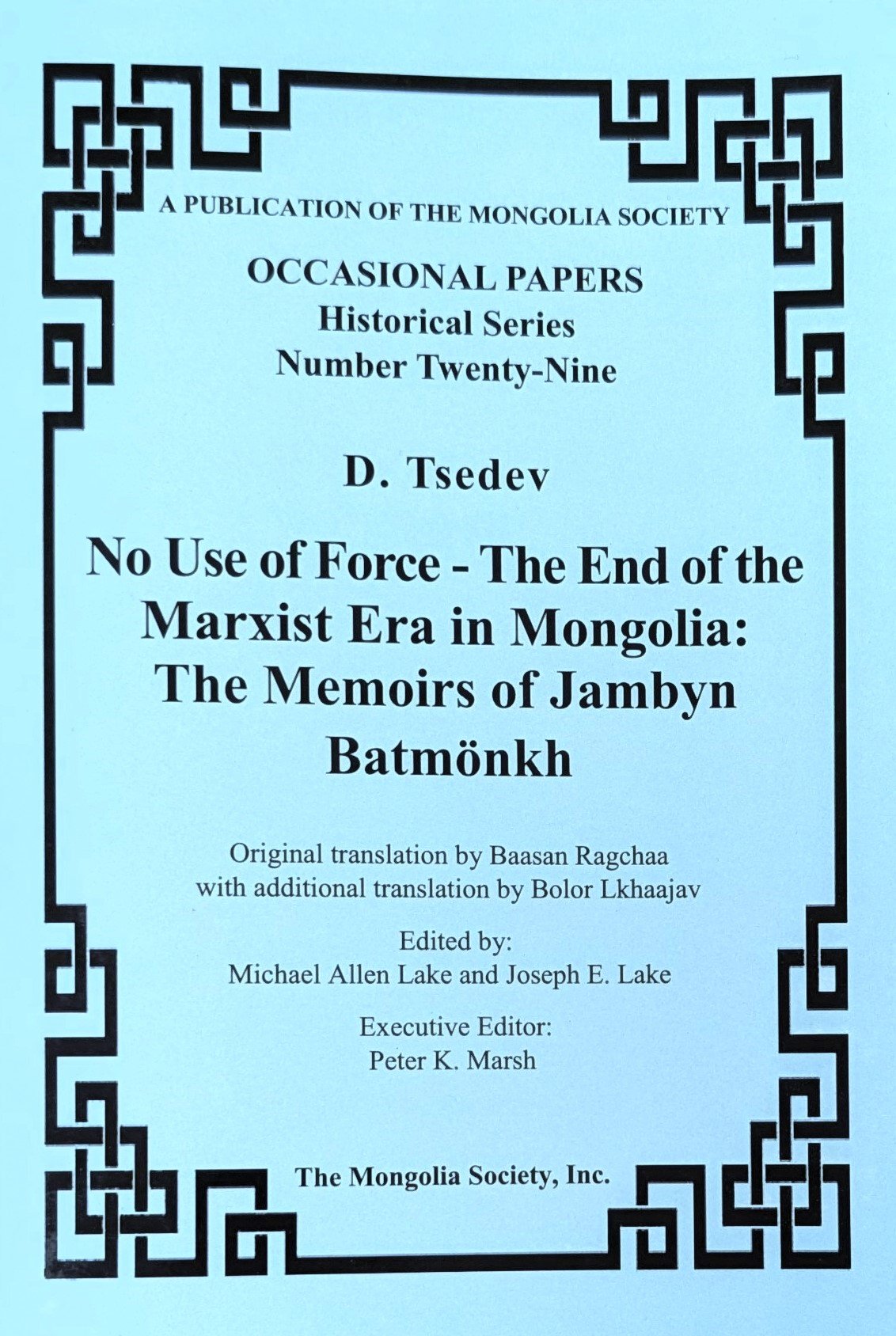
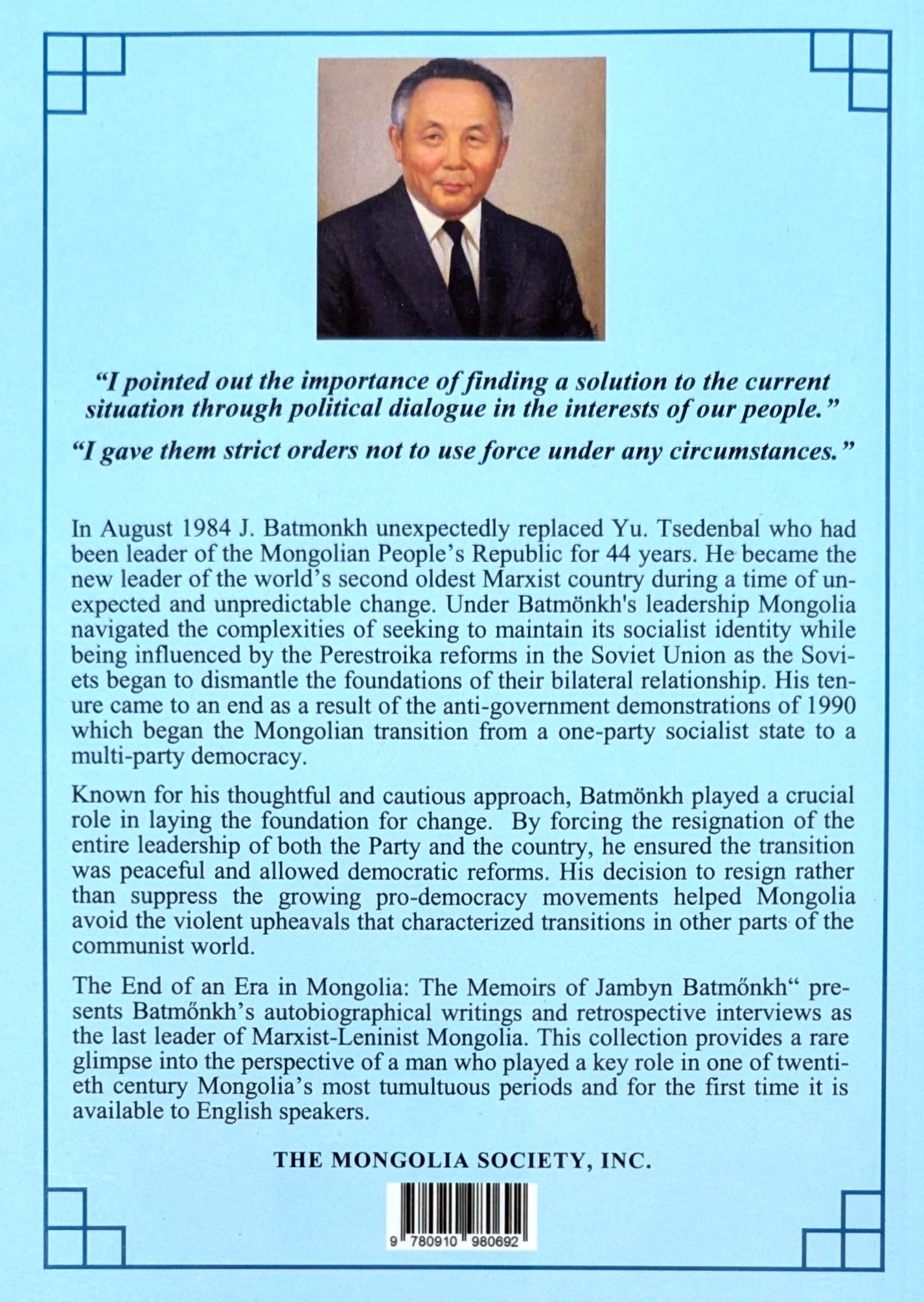
(Occasional Papers No. 29)
This translation of Jambyn Batmőnkh’s memoir presents his autobiographical writings and retrospective interviews as the last leader of Marxist-Leninist Mongolia and it provides a rare glimpse into the perspective of a man who played a key role in one of twentieth century Mongolia’s most tumultuous periods and for the first time it is available to English speakers.
Edited by Michael Allen Lake and Joseph E. Lake.
277 pages. ISBN 978-0-910980-69-2.
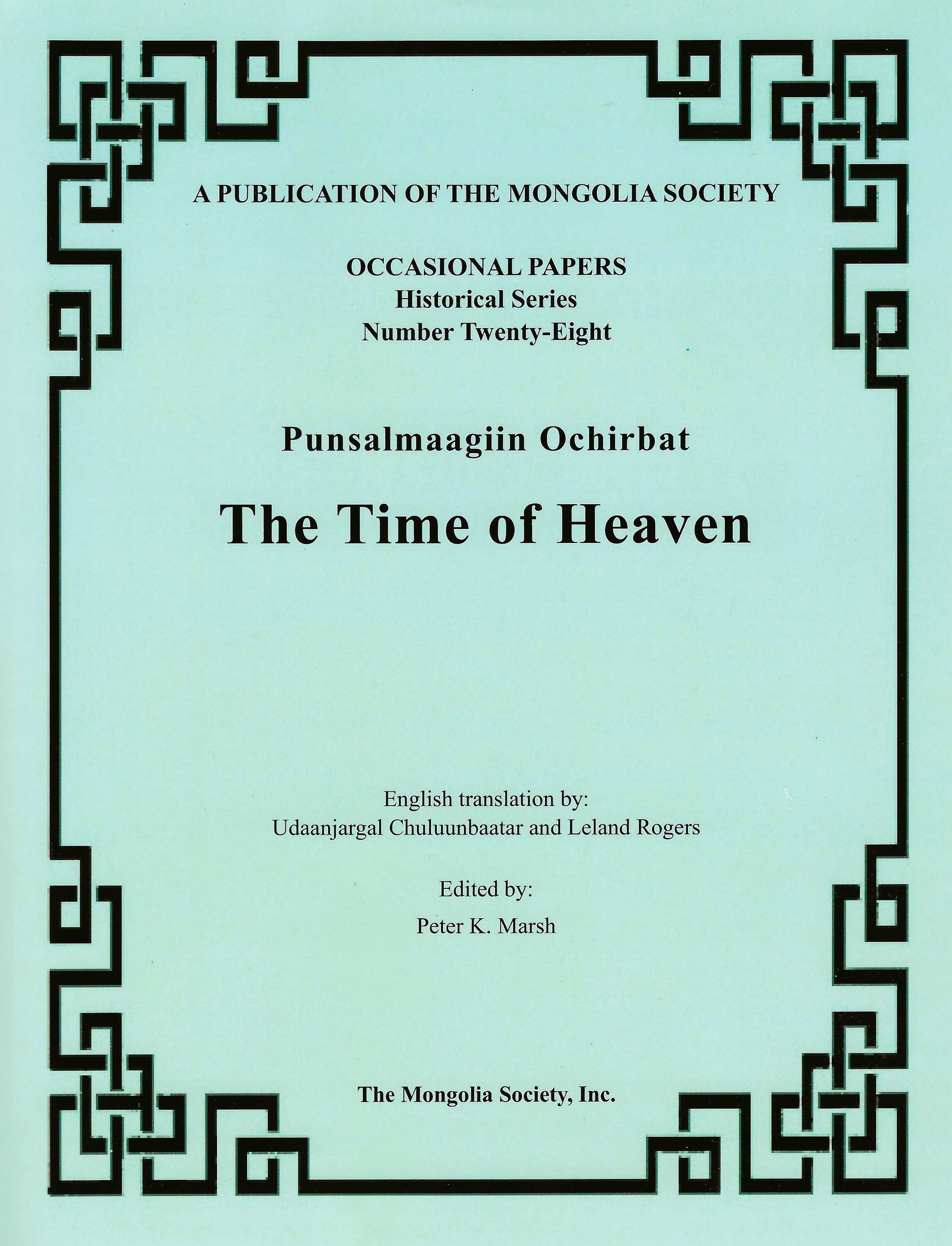
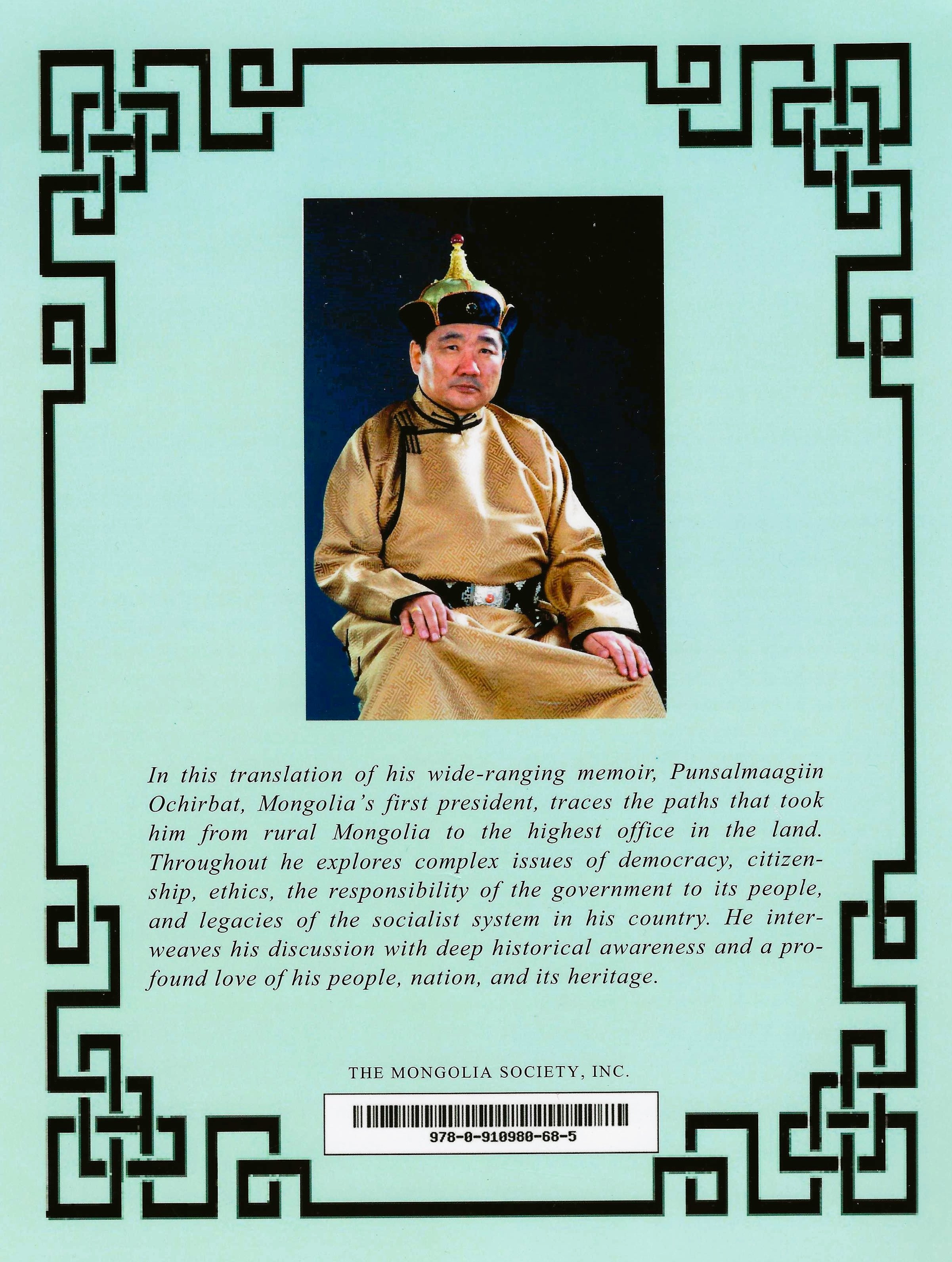
In this translation of his memoir, Punsalmaagiin Ochirbat, Mongolia’s first president, traces the paths that took him from rural Mongolia to the highest office in the land. Throughout he explores complex issues of democracy, citizenship, ethics, the responsibility of the government to its people, and legacies of the socialist system in his country. He interweaves his discussion with deep historical awareness and a profound love of his people, nation, and its heritage. 361 pages. ISBN 978-0-910980-68-5.
(Occasional Papers, No. 28)

A study of the various uses of the quotative verb kee- (written keme- in the Uighur-based script) in all reliable texts of Middle Mongolian, with special emphasis on quoted sentences in the Secret History. Topics covered include direct quotation, referential and indirect quotation, and uses of the passive ke(m)e-gde-. An index is included of some 450 passages cited or mentioned. 96 pages. ISBN 978-0-910980-67-8.
John C. Street
(Occasional Papers, No. 27)
In this work, Elverskog offers not only the first translation of the 1835 Subud Erike but also situates it within Mongol historiography of the Manchu period. In particular, he uses the work to challenge the conventional view of the imagined decline of Qing-period Mongol historical writing, especially the notion that it solely became a reflection of the state power. Instead, Elverskog shows how Mongol historians in nineteenth-century Ordos were maintaining their own vibrant and dynamic tradition. 196 pages. ISBN 978-0-910980-66-1.
Johan Elverskog
(Occasional Papers, No. 26)
"The unexpected change in the highest leadership of Mongolia in August 1984 still remains a mystery for many. According to official statements, Yumjaagiin Tsedenbal was relieved from his party and state posts “considering the poor condition of his health, and by his personal agreement." At the same time, certain circles of Mongolian society maintained a very firm and established opinion that his health was in good condition and that there were no serious grounds for his resignation. What then actually happened? Did Tsedenbal resign because of his poor health by his own will or was he removed against his will? Translated from the Russian by Baasan Ragchaa. 123 pages. ISBN 0-910980-65-9.
Sh. Nadirov
(Occasional Papers, No. 25)
A detailed chronology of the Mongol conquests. Robert Reid accurately summarizes the current knowledge about their campaigns, invasions, and civil wars from Chinggis Khan to Qubilai Khan and from Vietnam to Vienna. This is a must-have reference work for any student of the Mongol world empire. 108 pages. ISBN 910980-64-0.
Robert W. Reid
(Occasional Papers, No. 24)
Francis W. Cleaves,
Prof. Cleave’s important translation of Chapters 7-9 of this work, representing the final chapters he prepared, and chapters 10-17, which consist solely of the transcription and translation. 131 pages.
(The book of filial piety)
(Occasional Papers, No. 23)
A comprehensive work on the Mongolian economy, with data never before revealed about the Socialist years. Written by a doctor of economics who rose to ministerial level in the Socialist period, the book includes an inside view of both the achievements and mistakes of that era, and describes the traditional herding economy as well as the rocky road of transition to the current market economy. Edited by William V. Rozycki. 118 pages. ISBN 910980-62-4.
(Occasional Papers, No. 22)
John G. Hangin with John R. Krueger, Robert G. Service, William V. Rozycki, Paul D. Buell
This is a comprehensive anthology in English of Mongolian folk literature. 269 pages. ISBN 910980-61-6.
(Occasional Papers, No. 21)
This is the never-before published diary of Franz August Larson, known as the Duke of Mongolia, who spent over 46 years in China and Mongolia in the 1880s to 1930s. It includes personal reminiscences and comments not found in his published books. The diary is held by the Larson family collection. It is reprinted in its English original and Mongol translation done by G. Ganbold, who has also written an introduction to explain the significance of the work and to introduce Larson to new generations of Mongols and Mongolists. ISBN: 978-0-910980-36-4.
In this little guide, Dr. Michalove introduces the ’Phags-pa Lama’s so-called “Square Script” in a way that makes it easier for someone who already knows Classical Mongolian to master this Tibetan-based alphabet. It can be used independently or in conjunction with Poppe and Krueger’s 1957 guide to the ’Phags-pa script. Dr. Michalove has reprinted several ’Phags-pa script texts in a large and readable font and added supplementary information on the characters and their use, an updated bibliography, as well as a glossary of words and grammatical forms. 31 pages.
Text in Tibetan and Mongolian scripts, with an introduction in English by Stèphane Grivelet. A journal put out by the Mongolian government in the 1930s to propagandize its policies to the large lama population. Written partially in Mongolian script and partially in Mongolian written in Tibetan letters. 86 pages.
Samples from textbooks 1925-1930. Selection and preface by György Kara. Among the nations of the Russian Federation, the Kalmyks had the most laborious experiments with writing systems. Since the October Revolution in Russia (1917) their Western Mongol language has seen at least six reforms of orthography. The extracts reproduced in this publication are taken from four Moscow publications as examples of the different Cyrillic and Romanized orthographies that have been used. This publication also contains readings and illustrations depicting Kalmyk life and tradition. 133 pages.
Originally published in Moscow, in 1934, this very rare work in the Latin script that was used only between 1931 and 1937. It contains 21 Kalmyk melodies plus five other items, including a lengthy excerpt from the Janggar epic. Notes are given on a treble clef (the Janggar has a treble accompaniment). Each song has several verses. The publication also contains prefaces in Kalmyk and Russian languages. 52 pages.
No results match your search. Try removing a few filters.