News & Events
News on this page is organized into sections:
NEWS FROM THE SOCIETY
Society Announcements
Society Events
Society Publications
Society Visits, Exhibits & Lectures
NEWS FROM THE DIASPORA
NEWS FROM MONGOLIAN STUDIES
SOCIETY REMEMBRANCES
> NEWS FROM THE SOCIETY - ANNOUNCEMENTS
MonSoc’s 65th Annual Meeting to Honor Professor Henry G. Schwarz
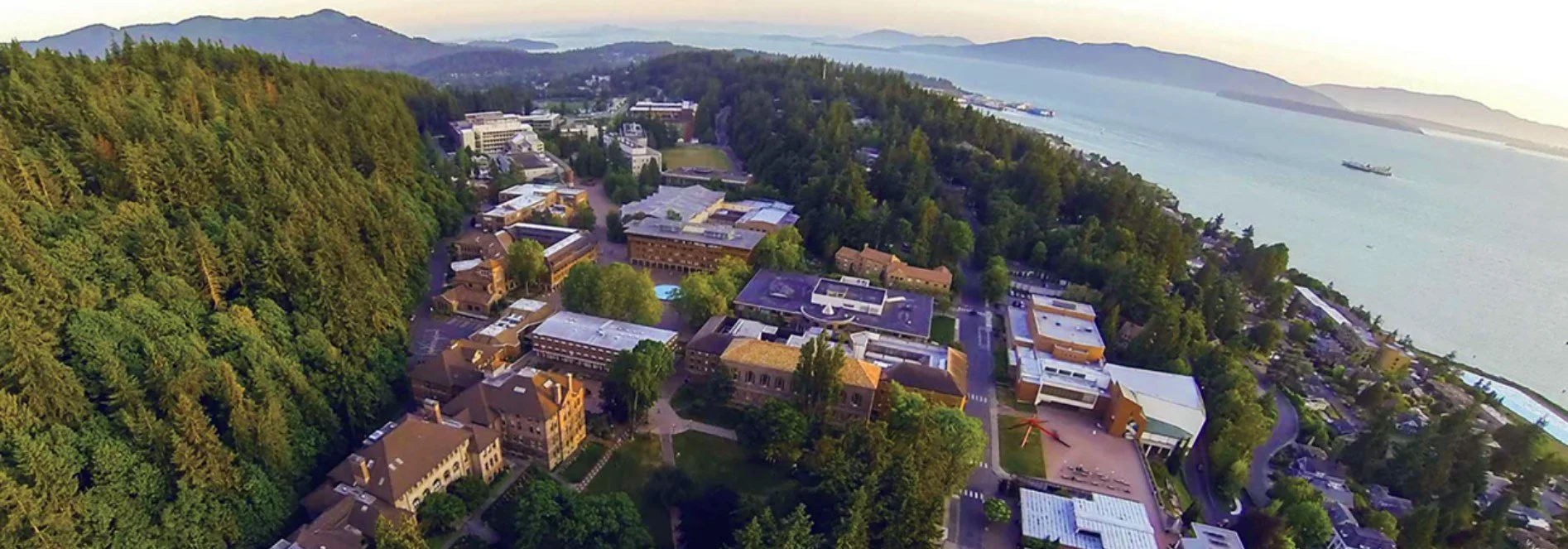
The Mongolia Society’s 65th Annual Meeting & Panels will be held October 2-3, 2026, at Western Washington University in Bellingham, Washington.
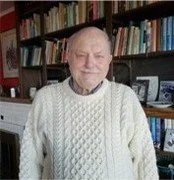
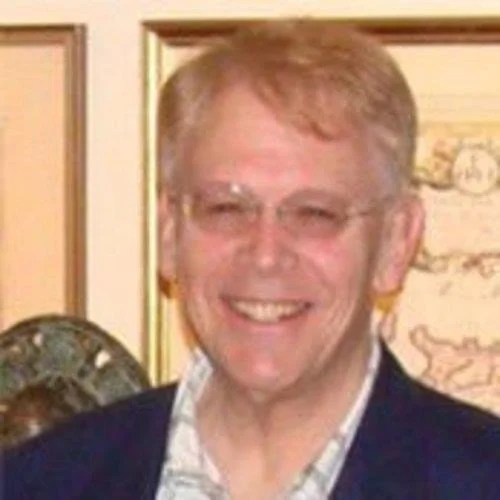
Prof. Henry G. Schwarz
This year’s meeting will honor Professor Henry G. Schwarz, Professor Emeritus at Western Washington University, whose scholarship, teaching, and institutional leadership have shaped the field of Mongolian Studies for more than half a century.
Western Washington University is an especially fitting site for the meeting. Under Professor Schwarz’s leadership, Western became one of the most important centers for Mongolian Studies in North America. Beginning in the 1970s, the university developed a strong program in East Asian and Mongolian Studies, offering courses in Mongolian history, culture, language, and literature. Western also helped establish a pioneering Mongolian language program for American students at Inner Mongolia University, hosted conferences and public programs, and built one of the most significant Mongolian Studies library collections outside Mongolia.
Professor Schwarz’s contributions extend well beyond Western Washington University. As a scholar, he has published widely on Mongolia, Inner Asia, ethnic minorities, and Mongols in China, helping to define key areas of research in the field. As a teacher and mentor, he has trained and encouraged generations of students and scholars. As a leader in The Mongolia Society, including service as its President, he has helped sustain the Society’s mission of supporting scholarship, exchange, and public understanding of Mongolia.
The 2026 Annual Meeting will bring together scholars, students, and friends of Mongolia for two days of panels, presentations, and conversation. The conference will be held in a hybrid format, with both in-person and virtual participation welcome.
For details about registration, membership requirements for presenters, attendance fees, special new-member rates, travel, and accommodations, please see our 65th ANNUAL MEETING INFORMATION PAGE
Deadline Extended on Hotel Accommodations for the 65th Anniversary Annual Meeting
The Mongolia Society recommends Hotel Leo, located in downtown Bellingham approximately one mile from Western Washington University. A block of rooms has been reserved for Annual Meeting participants through September 8, 2026. When booking, mention “Mongolian Studies Conference” to request the conference rate.
Hotel Leo - 1224 Cornwall Ave., Bellingham, WA 98225 / Website: www.thehotelleo.com / Phone: (360) 746-9097 / Email: booking@thehotelleo.com
Opportunity to Join the Society’s Board of Directors
December 15, 2025
Are you a Mongolia Society member and interested in serving on our organization’s Board of Directors? If so, contact Executive Director Susie Drost (email: monsoc@iu.edu) and ask to be put on the next The Mongolia Society ballot. The Board of Directors term is three (3) years.
> NEWS FROM THE SOCIETY - EVENTS
Mongolian Lunar New Year Tsagaan Sar Celebration, 2026
The Mongolian Lunar New Year (Tsagaan Sar) celebration—organized this year by the Mongolia Society, the Department of Central Eurasian Studies, the Mongolian Student Association at IU, and the Bloomington Mongolian Community—was held on February 14 at the Ferguson International Center.
The program opened with welcoming remarks from Öner Özçelik, Chair of the Department of Central Eurasian Studies; Susie Drost, Executive Director of the Mongolia Society; and Ayalguu Unensaikhan, President of the Mongolian Student Association at IU.
The cultural program began with a morin khuur (Mongolian horsehead fiddle) performance by Daniel Cotter. Mongolian language students performed the Mongolian folk song “Цагаан сар,” the Buryat folk song “Алтаргана,” and the Kalmyk folk song “Ээжийн дуун.” Joshua Sims and Anton Ermakov recited spring-themed poems in Khalkha Mongolian and Buryat, along with their own English translations. Ochmaa Dahszegve performed additional Mongolian folk songs on the yatga (Mongolian zither). The program also featured the traditional dance “Журай гэлдэн” and a fashion show showcasing traditional Mongolian clothing.
Guests enjoyed Mongolian milk tea, khuushuur (fried dough pockets filled with meat), and buuz (steamed dumplings) while celebrating an afternoon of music, poetry, and community.
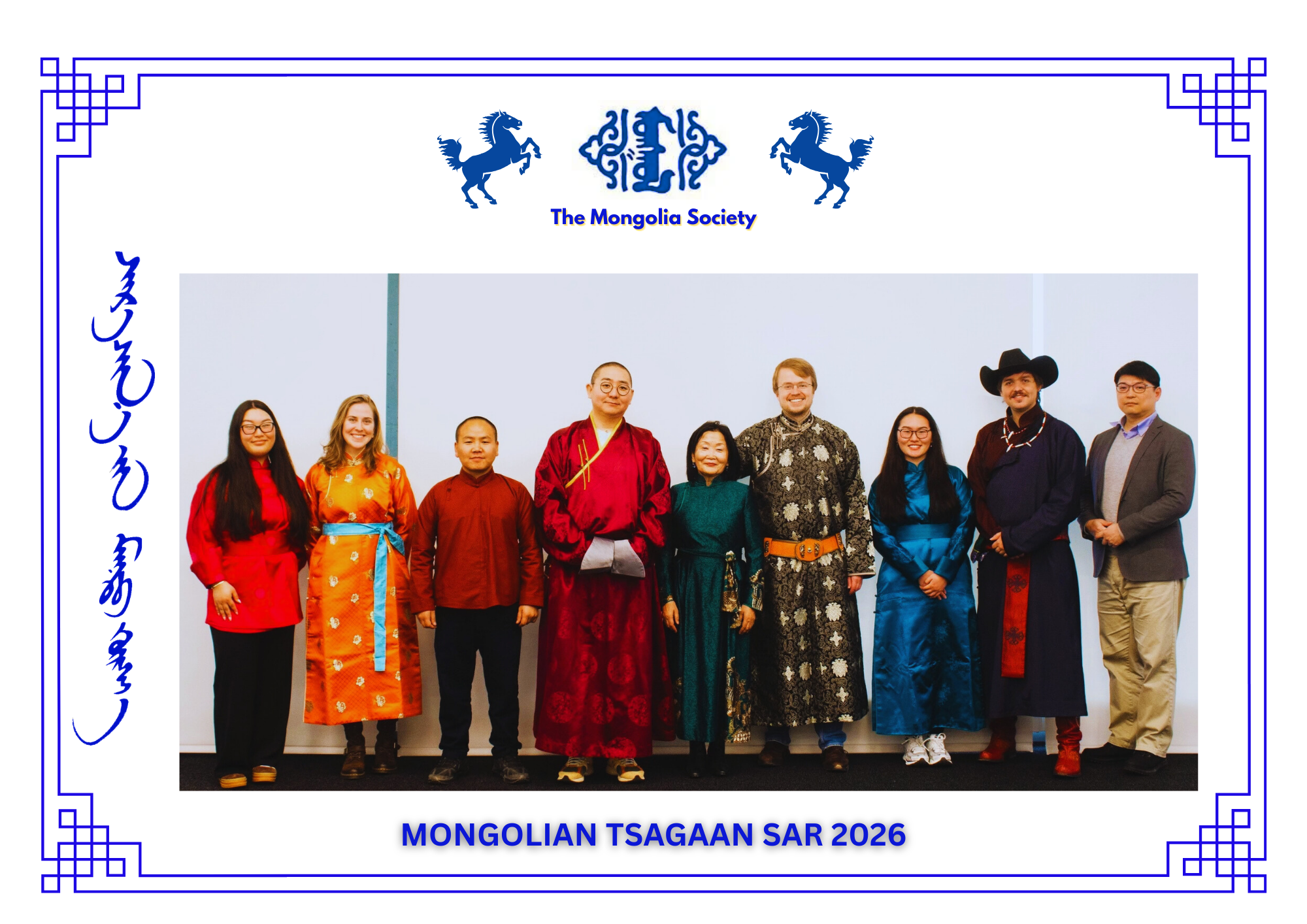
Below are some images (edited by B. Narazaya) of from the event:
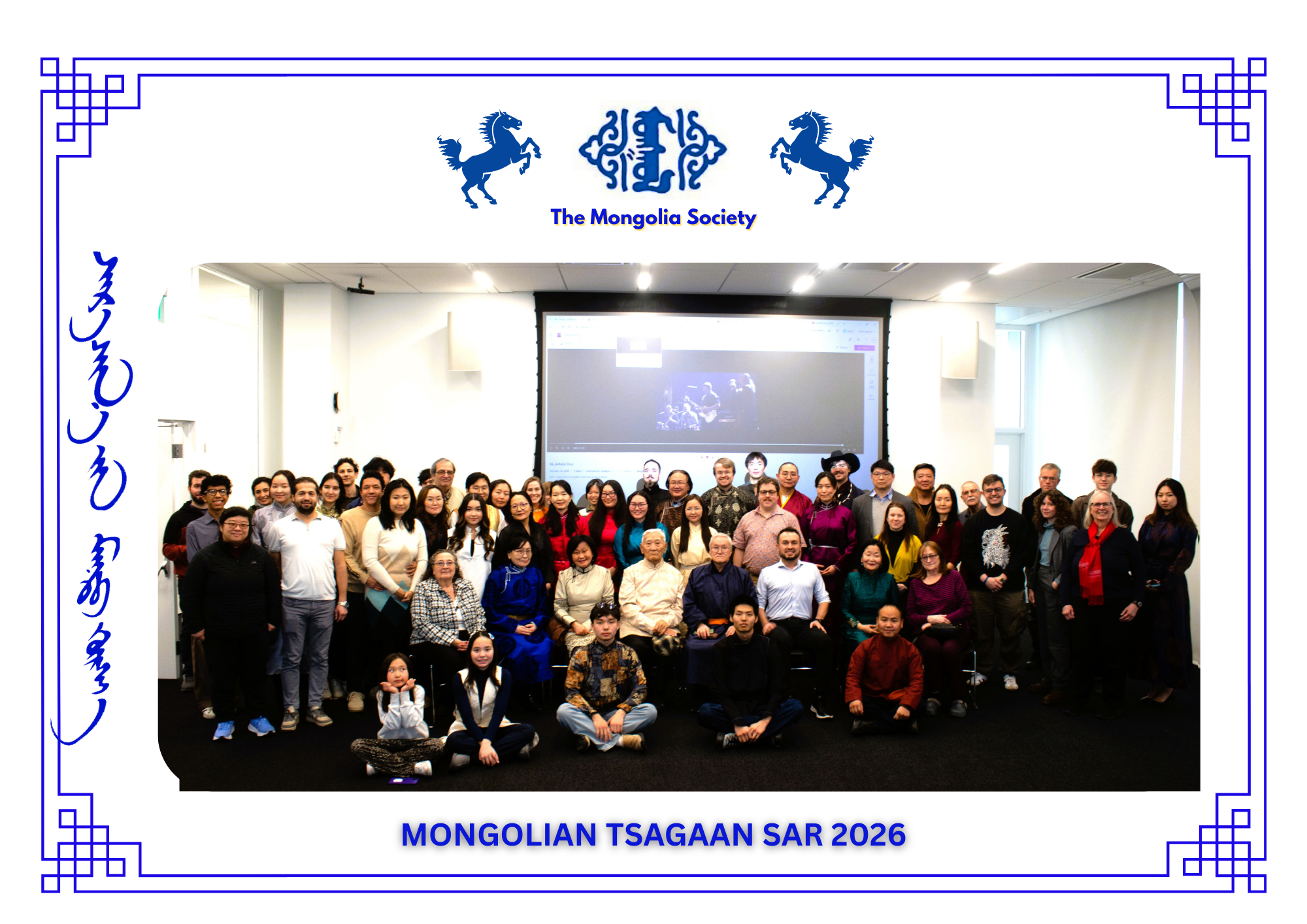
Event participants
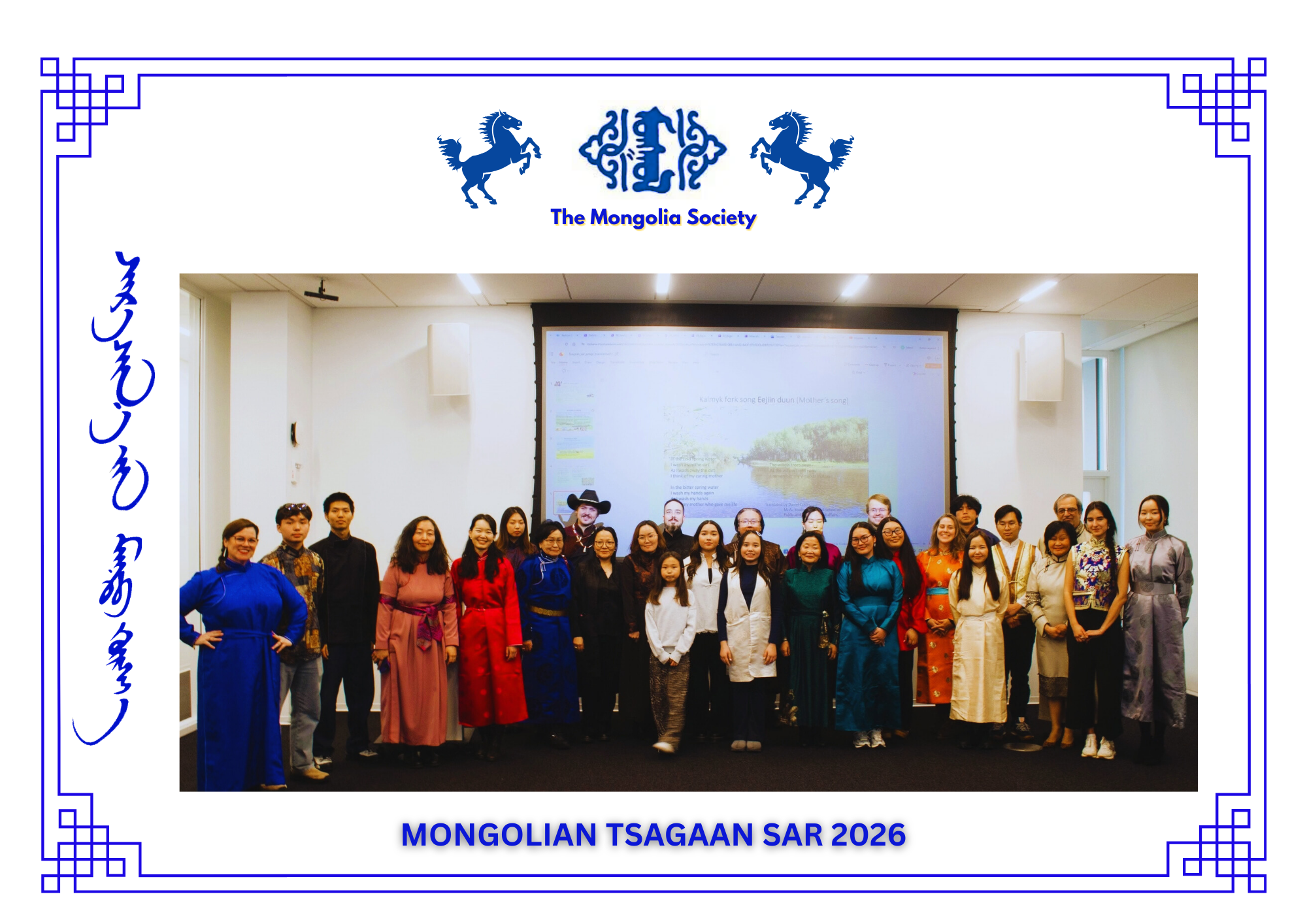
Fashion show participants at the celebration.
A group of IU students at the celebration with Mongolian language instructor Mrs. Tserenchunt Legden.
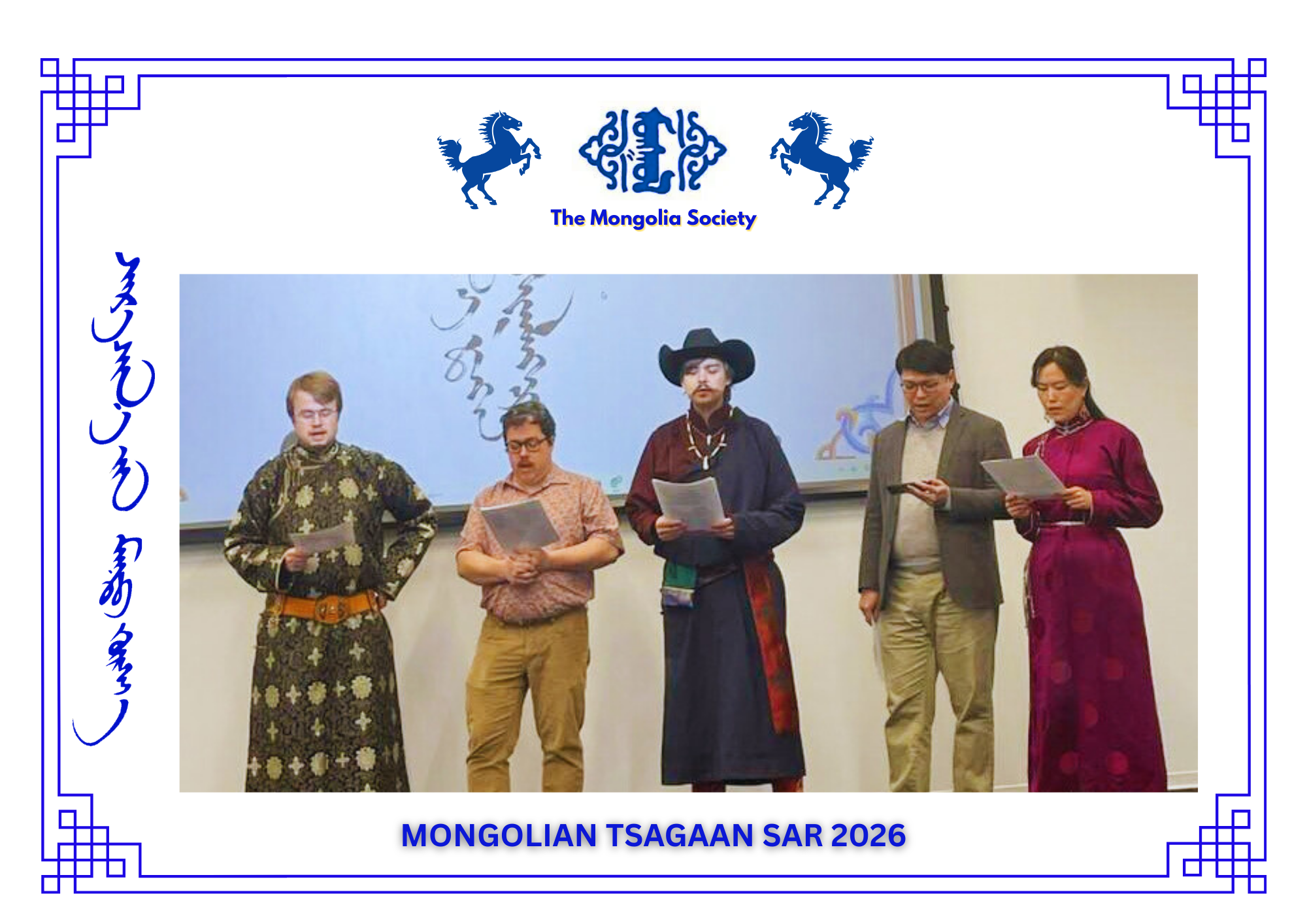
Mongolian language students perform the “Drinking Song.” From left to right: Joshua Sims, Anton Ermakov, Daniel Cotter, Wei Chieh Tsai, and Urshuu Wuerxiya.
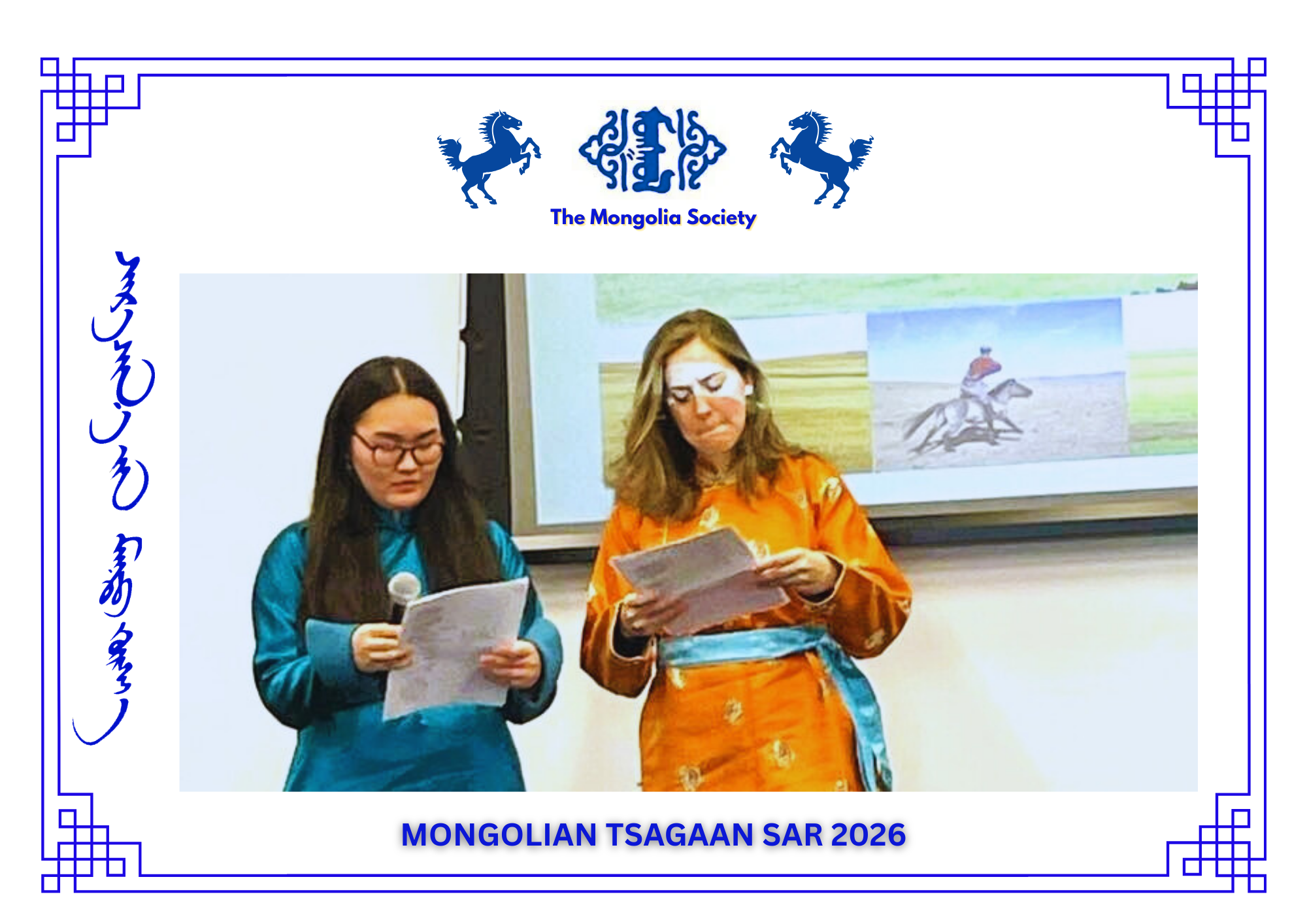
Julia Steffe and Khulan Otgonbayar, first-year Mongolian language students, performed the Western Mongolian folk song “Багын зан” (“The Character of Youth”) and the Buryat folk song “Алтаргана” (“Altargana”).
A Message from the Society’s President, Amb. (ret.) Michael Klecheski
December 15, 2025
Dear members and friends of The Mongolia Society,
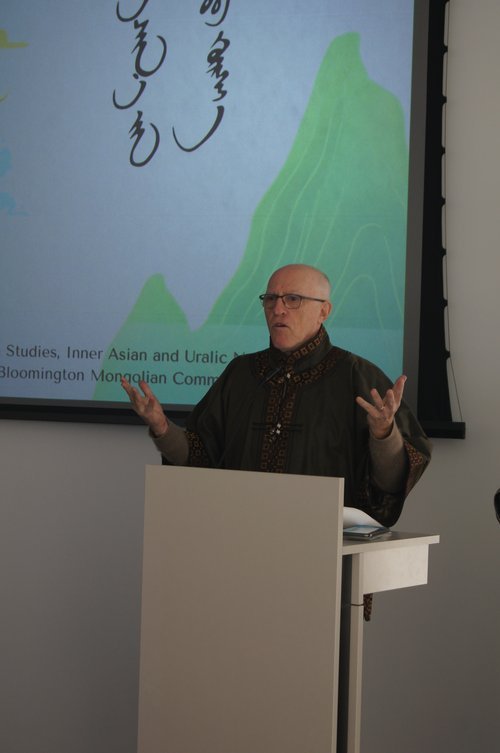
Amb. (ret.) Michael Klecheski
The Mongolia Society had another highly productive year, continuing to carry out the core mission it has pursued effectively for over six decades: advancing the study of Mongolia, notably its history, language and culture. In an unusually challenging period for scholarly institutions, however, the Society needs your support more than ever, making this year’s appeal for contributions particularly important.
As always, the Society’s annual meeting was a highlight of the past year, and this year, in-person and online participation was higher than it has been in recent memory. For the first time, the Society brought together all the former U.S. ambassadors to Mongolia to discuss their ambassadorships and the broader bilateral relationship. The transcript of that panel, when completed, should prove invaluable for scholars and policymakers. The three other panels also offered fascinating presentations on the changing Mongolian language, premodern connections and modern influences on Mongolia and its place in the world. A session at George Washington University focused on two decades of Smithsonian research in Mongolia. Mongolian Ambassador Batbayar Ulziidelger graciously hosted a reception for all the meeting participants.
Another highlight of the year was our publication of Occasional Paper 30, Reflections on the Checkered Century: The Memoirs of a Mongolian Ambassador, by Ambassador Uriankhan Jargalsaikhan. It is an interesting read, full of insights on recent Mongolian history and diplomacy. You can order your copy from our website (mongoliasociety.org) or by contacting the Mongolia Society office (monsoc@iu.edu).
Following the annual meeting, the Society began stepping up its social media presence. We hope that you will follow our Facebook and Instagram pages.
To accomplish its mission, the Society depends heavily on dues and donations. I do hope you will contribute again this year, as well as renewing your dues and considering putting the Society in your will.
We very much hope for your support!
Michael Klecheski Ambassador (ret.), President, The Mongolia Society
>NEWS FROM THE SOCIETY - PUBLICATIONS
The Society’s Latest Publication
October 15, 2025
Reflections on the Checkered Century: The Memoirs of a Mongolian Ambassador, by Uriankhan B. Jargalsaikhan (Occasional Papers #30, October 2025).
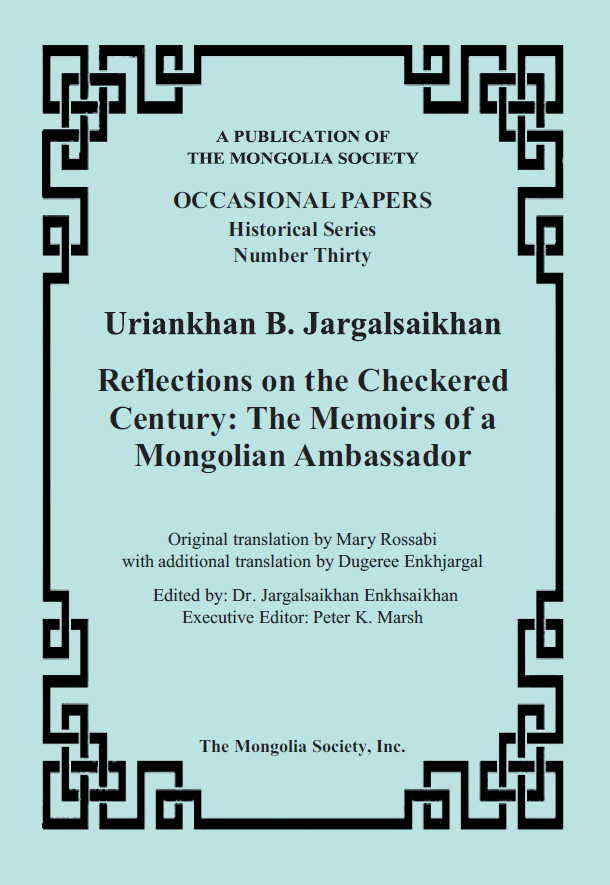
In Memoirs of a Mongolian Ambassador, U. B. Jargalsaikhan traces his five-decade-long career working in Mongolian’s foreign service during the checkered twentieth century. He reflects about how, during his student years in the 1930s, he witnessed Soviet efforts to instill a communist ideology into the life of the Mongolian people and to repress those, including the national elites and clergy, who dared to voice their doubts about them.
He writes in vivid detail about his first post, serving at the Mongolian Embassy in Moscow in 1941, and how he and his staff had to work in spite of German bombing of the city. He later served as Mongolia’s first Ambassador to China and discussed the establishment of bilateral relations with Chinese leader Mao Zedong.
Long an advocate for Mongolia’s membership in the United Nations, Jargalsaikhan was in the room in 1961, when this status was finally achieved. He served as Mongolia’s first Permanent Representative to the UN and later traveled throughout Europe, Africa, and Asia promoting bilateral relations.
This beautifully written and accessible memoir provides us with a behind-the-scenes look at the inner workings of the Mongolian government in a tumultuous and at times exciting period in its history.
Memoirs costs $38.00, plus postage, until November 1, 2026. After then, the cost will be $50.00, plus postage. (U.S. postage $5.50, overseas postage varies by destination.)
To purchase your copy of this publication, go to our Publications Publications page page.
> NEWS FROM THE SOCIETY - VISITS, EXHIBITS, & LECTURES
The Mongolian Consul-General Visits Indiana University
December 15, 2025
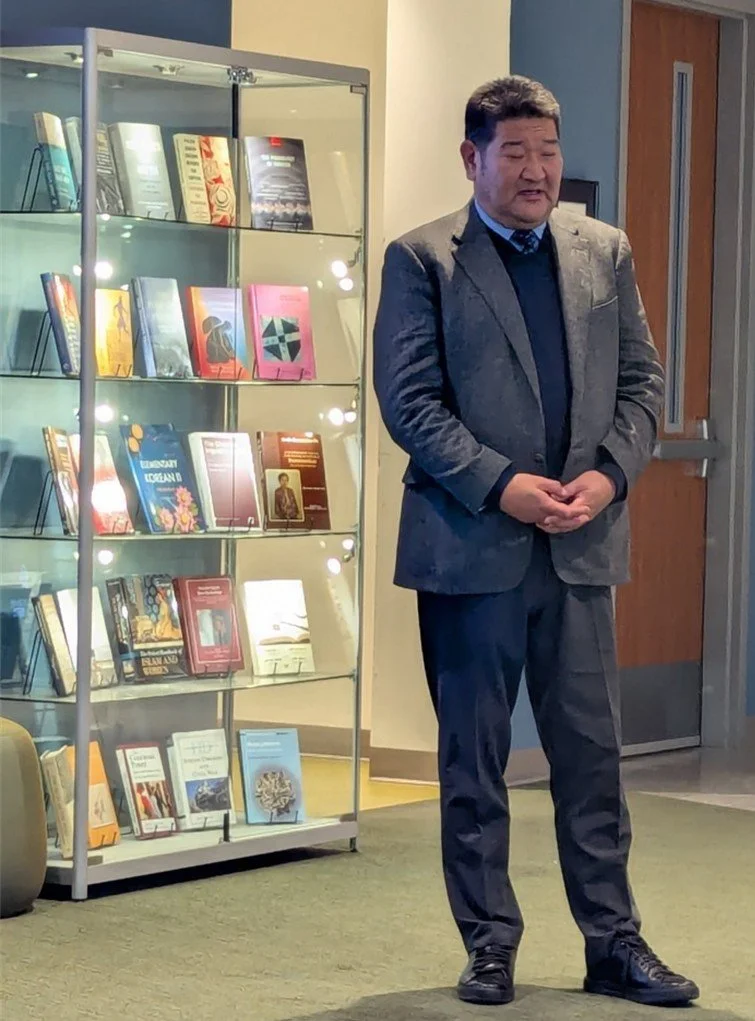
The Hamilton Lugar School of Global and International Affairs, in partnership with the Mongolia Society, hosted Mongolian Consul General Munkhbaatar Begzjav and a delegation of prominent Mongolian representatives at Indiana University in December.
During the visit, the delegation met with representatives from the Hamilton Lugar School and the Mongolia Society, visited Mongolia-related classes, and engaged with students studying the Mongolian language and related fields.
Director of the Zanabazar Museum of Fine Arts Visits Indiana University
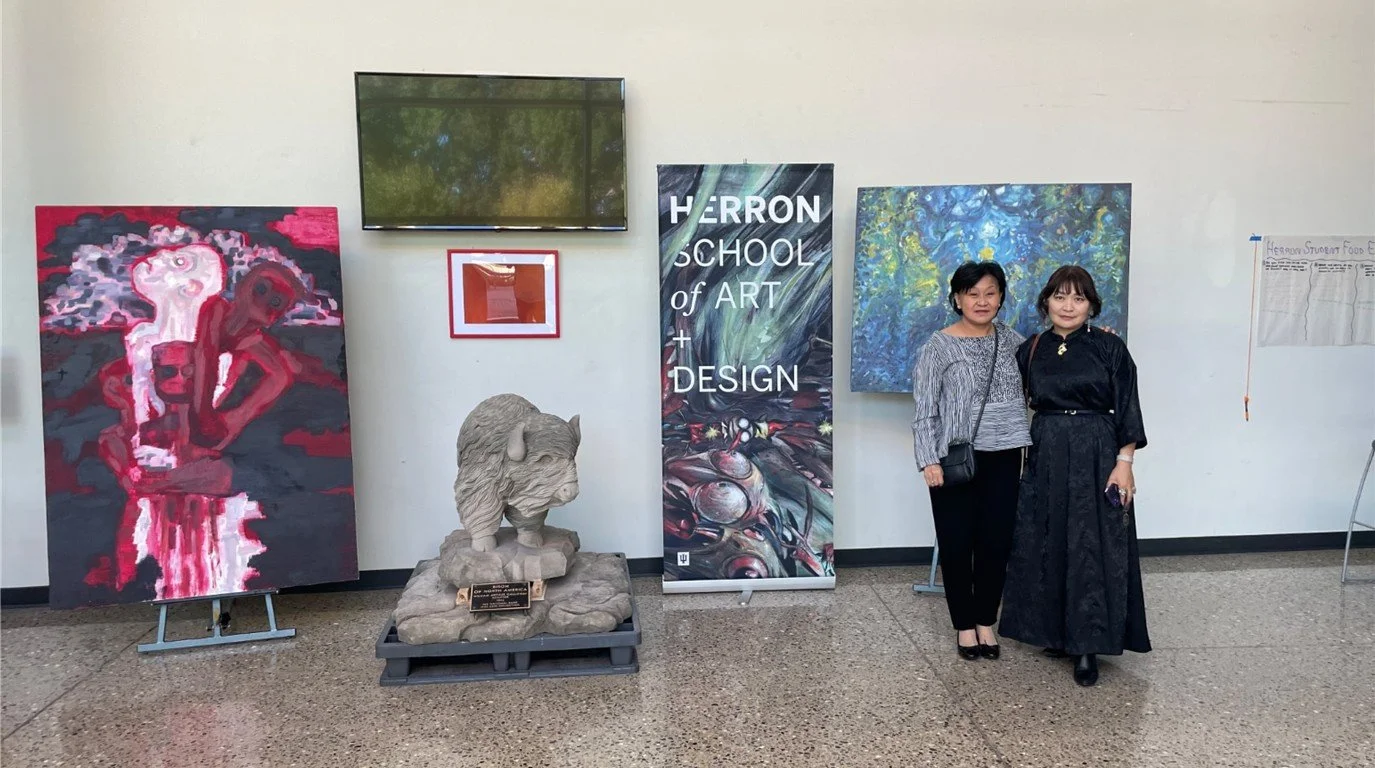
Dr. Baigalmaa Purevsukh, Director of the renowned Zanabazar Museum of Fine Arts, visited Indiana University this year.
During her visit, she toured several prominent artistic and literary institutions in Indiana, including the Lilly Library and the Eskenazi Museum of Art (pictured on the right with Mongolia Society Board Member, Prof. Orna Tsultem).
The Society’s President, Ambassador Michael Klecheski (Ret.), Presents a Lecture on Mongolia’s Independence
March 1, 2024

The Mongolia Society’s President, Amb. Michael Klecheski
Ambassador Michael Klecheski, the U.S. Ambassador to Mongolia from 2019 to 2022, presented a Mongolia Society lecture, “Mongolia’s Third Neighbor Policy in Practice: A Case Study from a former U.S. Ambassador’s Years in Mongolia,” on February 20, 2024. Lecture attendees–students, faculty, and Mongolia Society members–gathered around a large discussion table at the Global and International Studies Building on the campus of Indiana University, Bloomington, or watched via a Zoom link.
The Ambassador discussed the challenges and successes that helped strengthen Mongolia’s independence “in a tough neighborhood.” In response to the question, “How does Mongolia, landlocked between China and Russia, maintain its independence and democratic system?,” he pointed to the nation’s so-called “third neighbor” policy, which seeks out good ties with other countries, the United States in particular, as being one key factor in maintaining its independence. As the U.S. Ambassador to Mongolia, Michael Klecheski was instrumental in that policy’s implementation and he shared his own personal experiences with this process.
A video recording of this lecture is available here: YouTube
Michael Klecheski retired from the U.S. State Department after his years as Ambassador to Mongolia. That was the last assignment of his over 35 years as an American diplomat, during which he served abroad in Russia, Kazakhstan and elsewhere, and in Washington D.C. on the Department’s 24-hour Operations Center and the NATO Desk. He also served as Director (and for a time, Acting Senior Director) for Russia at the National Security Council.
Currently President of The Mongolia Society, the Ambassador has a M.A. and M.Phil from Columbia University in political science and a BSFS (Bachelor of the Science of Foreign Service) from Georgetown University. He also has an honorary doctorate from the Mongolian National University.
NEWS FROM THE SOCIETY - NEWS FROM THE DIASPORA
The Fourth Morin Khuur Festival in the USA Willl Be Held in Denver, May 2026
The Fourth Morin Khuur Festival in the United States will take place on May 8-10, 2026, at the Robert and Judi Newman Center for the Performing Arts at the University of Denver. Continuing the work of previous festivals, the 2026 event will bring together musicians, scholars, instrument makers, and cultural enthusiasts to celebrate and explore the contemporary development of the morin khuur, Mongolia’s iconic horsehead fiddle.
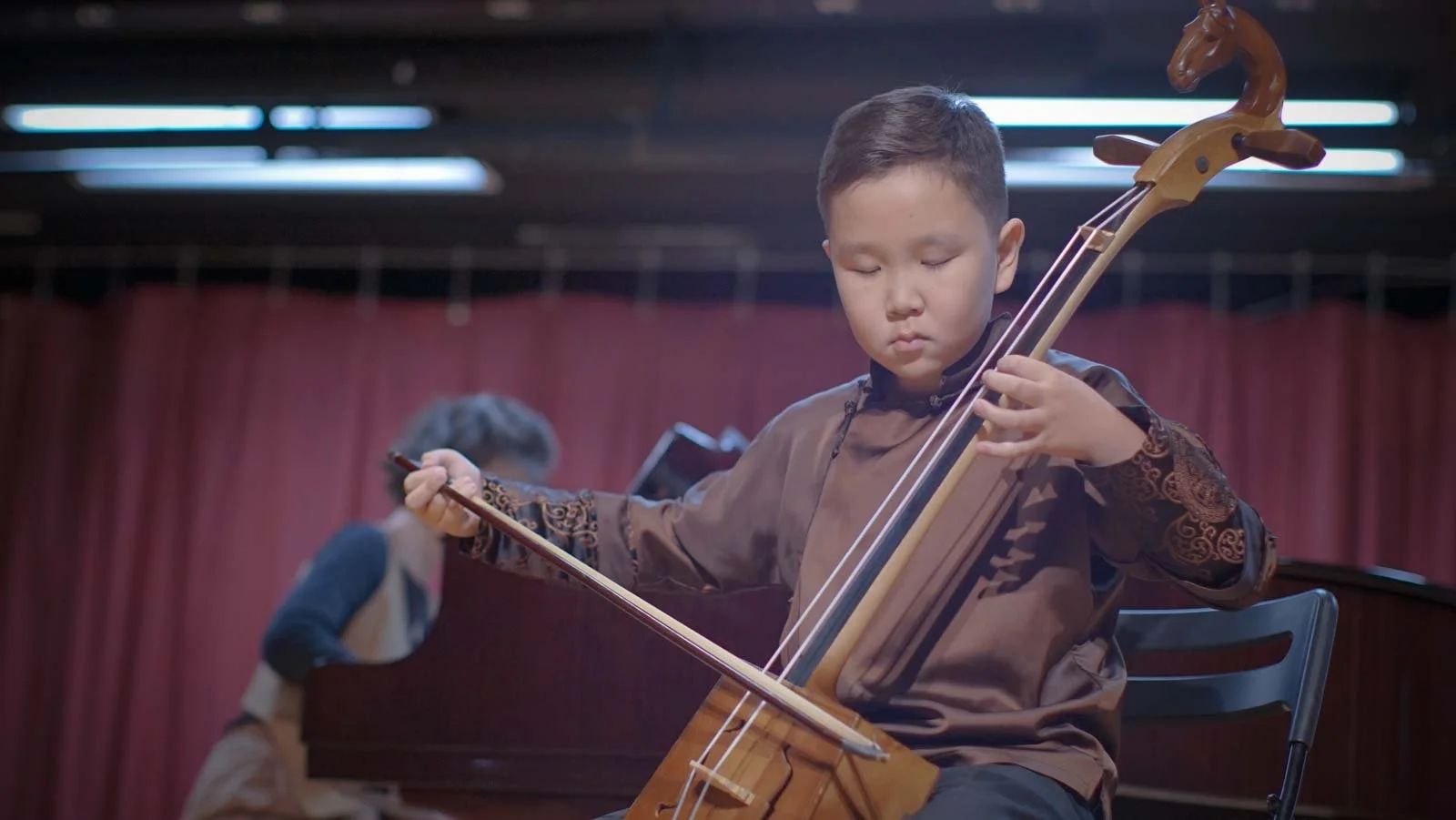
This year’s festival aims to foster dialogue between amateur and professional performers, highlight current trends in instrument making and performance practice, and consider new directions for the morin khuur’s evolution in the twenty-first century. Alongside the scholarly program, the festival will feature concerts, master classes, panel discussions, and a competition for amateur players. The organizers hope the event will strengthen awareness of Mongolian musical culture in the United States and support Mongolian communities in maintaining their heritage.
For more information, see the homepage of the Morin Khuur Center of North America: www.mkcna.org.
NEWS FROM THE SOCIETY - REMEMBRANCES
The Society Remembers Steve Richard Saunders (1946-2025)
December 15, 2025
The Mongolia Society mourns the passing of Steven Richard Saunders, who died on July 5, 2025, leaving be-hind a profound legacy as a diplomat, businessman, and one of Mongolia’s most steadfast "Third Neighbor" advocates.
Steve’s career was defined by an “unquenchable thirst for knowledge” and a rare gift for human connection. After serving as Assistant U.S. Trade Representative, he turned his focus to the Pacific Basin, eventually be-coming President of the North America-Mongolia Business Council (NAMBC). His work went far beyond com-merce; he was a foundational figure in the democratic transition of Mongolia.
Former Mongolian President and Prime Minister Tsakhia Elbegdorj paid tribute to Steve’s early commitment to the nation on the X platform, noting that Steve arrived in the 1990s as a pioneering advisor when the country was taking its first bold steps toward democracy. “Steve's message was consistent and clear: Mongo-lia matters, and Mongolia is ready,” Elbegdorj wrote. He further characterized Steve as “a mentor, a tireless bridge-builder, and a steadfast believer in Mongolia’s promise.”
His dedication did not go unnoticed by the Mongolian state. Steve was awarded the Order of the Polar Star, the highest tribute Mongolia bestows upon a foreign citizen. As his obituary noted, he developed a “special relationship with Mongolia’s people and their culture,” a bond reflected in his personal collection of Asian art and his deep friendships in Ulaanbaatar.
Beyond his professional accolades, Steve was a man of wit and “infectious personality” who mentored many in the field. He is survived by his wife of 48 years, Maureen Collins Saunders, and their children. As President Elbegdorj concluded, “Perhaps [his] greatest gift was his ability to bring people from vastly different back-grounds closer together.” The Mongolia Society extends its deepest condolences to the Saunders family.
The Society Remembers Dr. György Kara
October 19, 2022

Photo by Y. Boldbaatar. Used with permission.
As we end 2022, we reflect on those dear friends and colleagues we lost this year. In particular, our Society remembers Dr. György Kara, or Khar Dorj, as he was known to his many students, friends, and colleagues. A long-time member of the Mongolia Society and long-time Chairman of the Board, Dr. Kara was a much-beloved instructor, mentor, and colleague. The following is a brief summary of his life and contributions to our field.
Dr. Kara’s Career Achievements
Dr. Kara was Professor of The Hamilton Lugar School of Global and International Studies and Professor emeritus of ELTE University in Budapest, Hungary. From 1970-2000, he served as chairman of the Department of Inner Asian Studies at ELTE and from 1973-2005, as head of the Research Group for Altaic Studies of the Hungarian Academy of Sciences. For several years, he also served as chairman of ELTE’s Department of East Asian Studies and director of its Institute of Oriental Studies.
He was a member of the Hungarian Academy of Sciences and of the Committee of Oriental Studies of the Hungarian Academy of Sciences. From 1958-2005, he taught Mongol, Tibetan and Tungusic language courses at ELTE University in Budapest. He did the same at Indiana University in Bloomington, where he was invited, in 1986, to teach a broad range of subjects, including Altaic linguistics, Classical Mongol, Buriat, Manchu, Ewenki, Chuvash, Old Turkic structure, Old Turkic in various scripts, Mongolic languages and dialects, Shamanism and folk religion of the Mongols, their traditional civilization, literature, folklore, writing systems and phonetic history as well as several new courses for Department of Central Eurasian Studies. He continued teaching at Indiana University until his last stay in the hospital in April 2022.
Dr. Kara was an internationally respected scholar in his field. Expert in Mongolic languages and cultures, Altaic philology and Inner Asian cultural history, he contributed more than 400 publications on Mongolic, Turkic, Tungusic and Tibetan studies.
Dr. Kara was a member of the editorial board of professional journals and serials in Hungary, Russia, the United States, and China. He did field work and research, edited several important documents of Mongol language, cultural and literary history, translated old and new Mongol literature, recorded and analyzed oral texts, and described some hitherto unexplored dialects. He was a guest in the School of Oriental and African Studies, University of London; spent a year as senior researcher in Europe’s largest collection of Mongol old books and manuscripts in St. Petersburg, Russia; was visiting scholar in Japan, between the 1970s and 2002 did regular research work in the Turfan Collection of the Berlin-Brandenburg Academy of Sciences in Germany.
He was recipient of the Alexander von Humboldt Forschungspreis, the Pole Star Order and Labor Merit Order of Mongolia, the Gold Medal of the Permanent International Altaistic Conference, the Alexander Csoma de Kőrös Prize, the Europa Publishing House Prize (Budapest), and diploma of honor from the Ministry of Foreign Affairs of Mongolia. He was an honorary member of the Central Eurasian Studies Society (USA), the International Association of Mongolian Studies (Ulaanbaatar), and the Turkish Language Society (Ankara). Some of his anniversaries were honored with six collections of papers. No less than seven Festschrifts have been published in his honor.
The following statements were made by several of Dr. Kara’s colleagues. They were posted to the Facebook page of the Hamilton Lugar School of Global and International Studies. A forthcoming issue of the Society’s journal Mongolian Studies will honor Dr. Kara’s contributions to our field.
Öner Özçelik, Central Eurasian Studies Chair: “I feel very fortunate that, last Spring, I was able to audit his course 'Old Turkic',” said Özçelik. “He was truly devoted to his field; he could have hours of discussion about the origins of a single word, and in doing so, he could take you on a trip from one end of the world to another. He cared a lot about his students, who meant the world to him. He even tried to continue his three classes this semester even through hospital stays, in heroic Professor Kara fashion. Beyond his scholarship and teaching, despite his deep knowledge about the field, he was a very humble person, and always added some humor to his conversations. He will be truly missed."
Dr. Jamsheed K. Choksy, CEUS Distinguished Professor: “While I was chair of the department, every summer he would visit Hungary for research. He would always ask me if there was anything he could do to further IU or the department while in Hungary,” Choksy shared. “He always placed the students first, right to the end. Professor Kara’s knowledge will be impossible to replace.”
Professor Christopher Atwood, University of Pennsylvania: “A life can’t be summed up in the printed word, but my teacher … could be captured in his voice,” said Atwood. “That slight frown, that quiet laugh, that distinctive accent, that eccentric vocabulary full of amusing witticisms and insights — that was him. No one who learned from Professor Kara would ever denigrate precise and exact knowledge … but remembering his living voice, I know its limits. Amurlingui noirsooroi, bagsh aa.”
As our Society grieves for our friend and colleague, Professor György Kara, our hearts go out to his family during this difficult time.