
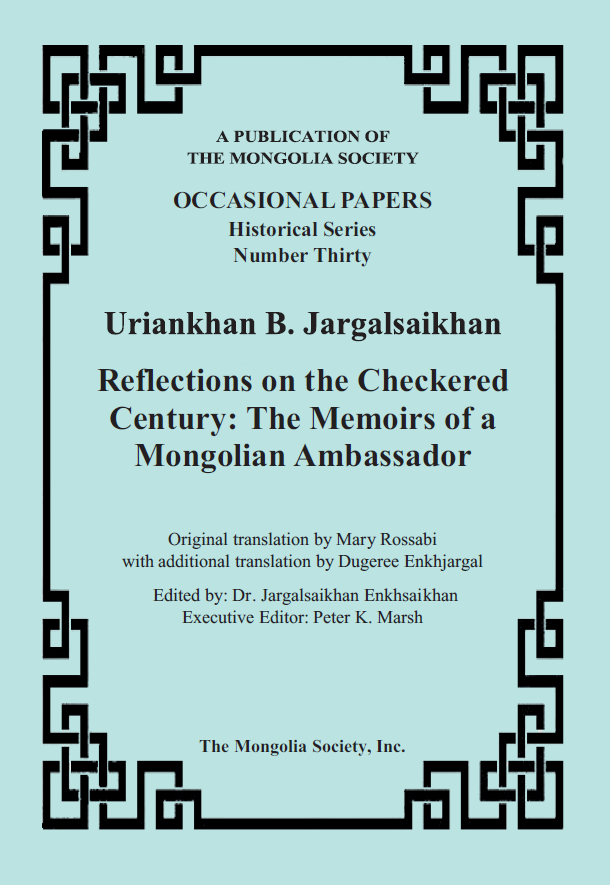
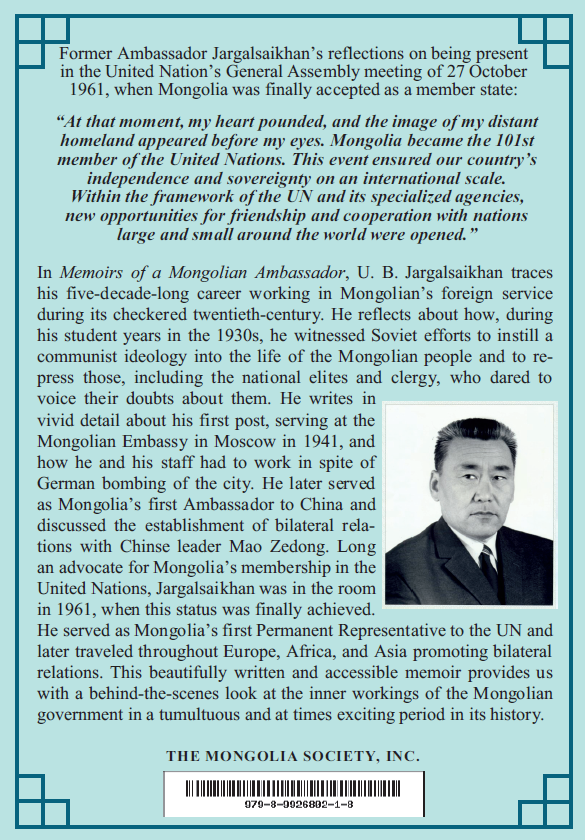
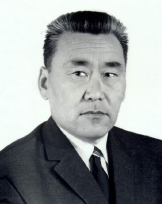
In Memoirs of a Mongolian Ambassador, U. B. Jargalsaikhan traces his five-decade-long career working in Mongolian’s foreign service during the checkered twentieth century. He reflects about how, during his student years in the 1930s, he witnessed Soviet efforts to instill a communist ideology into the life of the Mongolian people and to repress those, including the national elites and clergy, who dared to voice their doubts about them.
He writes in vivid detail about his first post, serving at the Mongolian Embassy in Moscow in 1941, and how he and his staff had to work in spite of German bombing of the city. He later served as Mongolia’s first Ambassador to China and discussed the establishment of bilateral relations with Chinese leader Mao Zedong.
Long an advocate for Mongolia’s membership in the United Nations, Jargalsaikhan was in the room in 1961, when this status was finally achieved. He served as Mongolia’s first Permanent Representative to the UN and later traveled throughout Europe, Africa, and Asia promoting bilateral relations.
This beautifully written and accessible memoir provides us with a behind-the-scenes look at the inner workings of the Mongolian government in a tumultuous and at times exciting period in its history.
Memoirs costs $38.00, plus postage, until November 1, 2026. After then, the cost will be $50.00, plus postage. (U.S. postage $5.50, overseas postage varies by destination.)

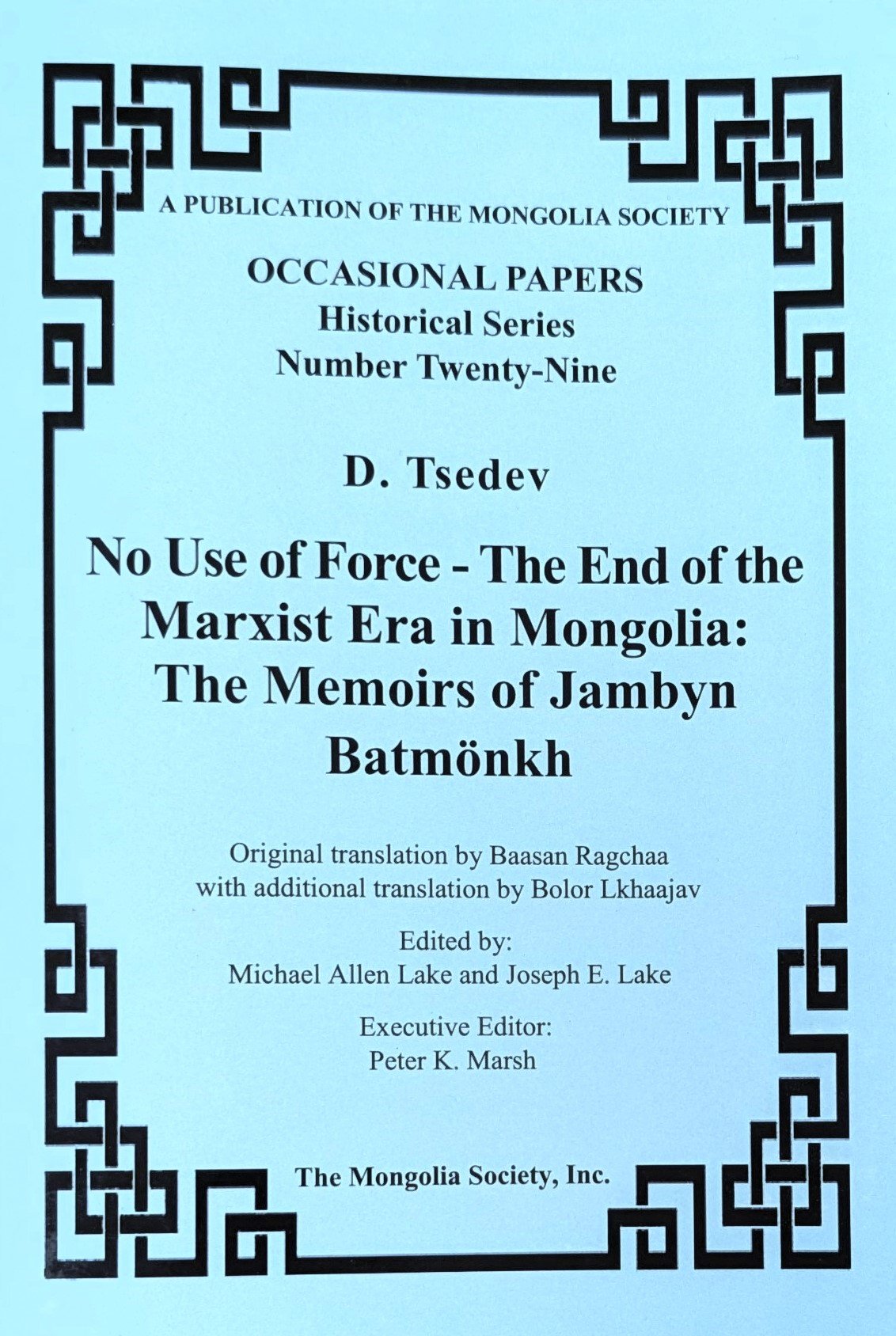
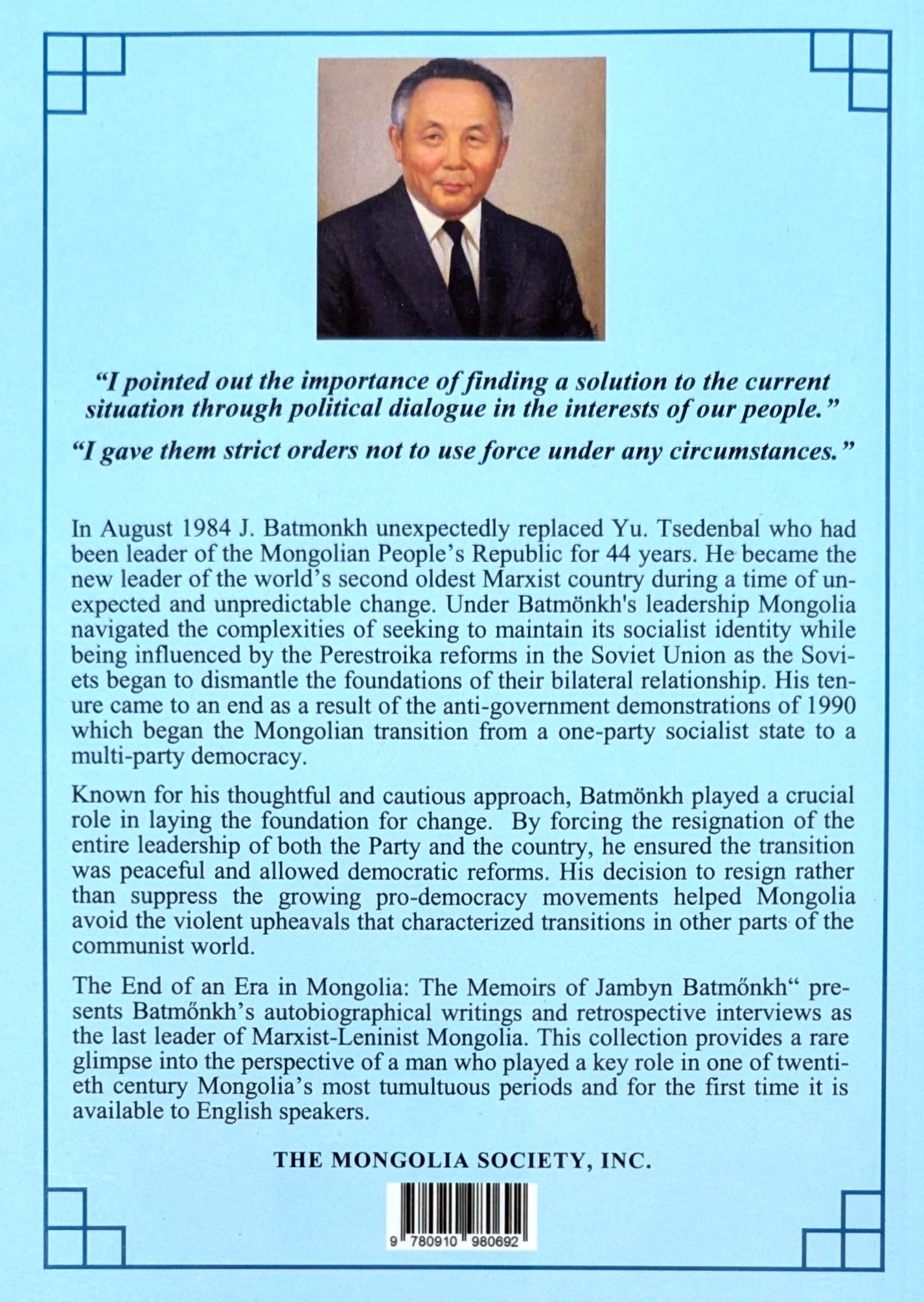
(Occasional Papers No. 29)
This translation of Jambyn Batmőnkh’s memoir presents his autobiographical writings and retrospective interviews as the last leader of Marxist-Leninist Mongolia and it provides a rare glimpse into the perspective of a man who played a key role in one of twentieth century Mongolia’s most tumultuous periods and for the first time it is available to English speakers.
Edited by Michael Allen Lake and Joseph E. Lake.
277 pages. ISBN 978-0-910980-69-2.
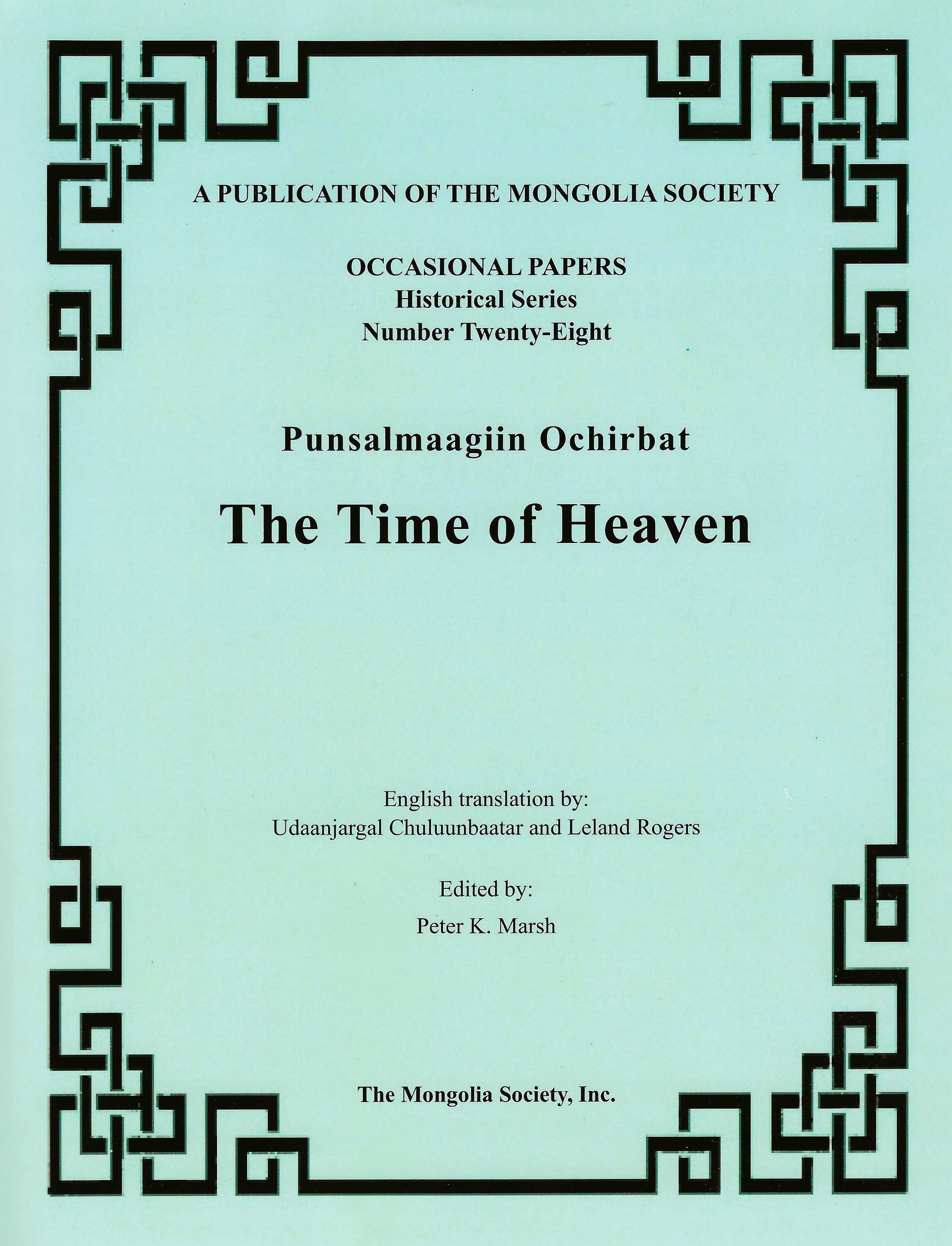
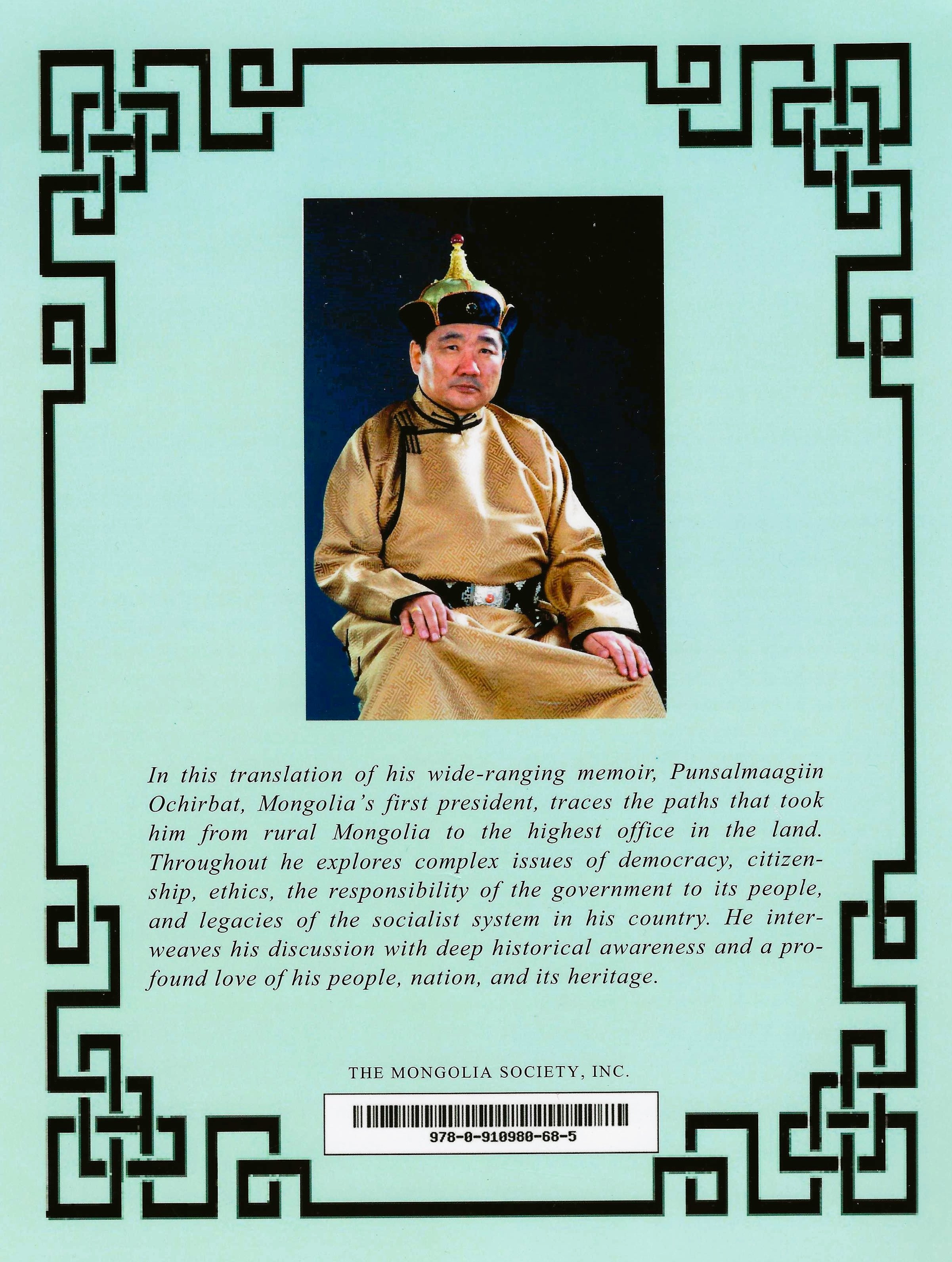
In this translation of his memoir, Punsalmaagiin Ochirbat, Mongolia’s first president, traces the paths that took him from rural Mongolia to the highest office in the land. Throughout he explores complex issues of democracy, citizenship, ethics, the responsibility of the government to its people, and legacies of the socialist system in his country. He interweaves his discussion with deep historical awareness and a profound love of his people, nation, and its heritage. 361 pages. ISBN 978-0-910980-68-5.
(Occasional Papers, No. 28)

A study of the various uses of the quotative verb kee- (written keme- in the Uighur-based script) in all reliable texts of Middle Mongolian, with special emphasis on quoted sentences in the Secret History. Topics covered include direct quotation, referential and indirect quotation, and uses of the passive ke(m)e-gde-. An index is included of some 450 passages cited or mentioned. 96 pages. ISBN 978-0-910980-67-8.
John C. Street
(Occasional Papers, No. 27)
In this work, Elverskog offers not only the first translation of the 1835 Subud Erike but also situates it within Mongol historiography of the Manchu period. In particular, he uses the work to challenge the conventional view of the imagined decline of Qing-period Mongol historical writing, especially the notion that it solely became a reflection of the state power. Instead, Elverskog shows how Mongol historians in nineteenth-century Ordos were maintaining their own vibrant and dynamic tradition. 196 pages. ISBN 978-0-910980-66-1.
Johan Elverskog
(Occasional Papers, No. 26)
"The unexpected change in the highest leadership of Mongolia in August 1984 still remains a mystery for many. According to official statements, Yumjaagiin Tsedenbal was relieved from his party and state posts “considering the poor condition of his health, and by his personal agreement." At the same time, certain circles of Mongolian society maintained a very firm and established opinion that his health was in good condition and that there were no serious grounds for his resignation. What then actually happened? Did Tsedenbal resign because of his poor health by his own will or was he removed against his will? Translated from the Russian by Baasan Ragchaa. 123 pages. ISBN 0-910980-65-9.
Sh. Nadirov
(Occasional Papers, No. 25)
A detailed chronology of the Mongol conquests. Robert Reid accurately summarizes the current knowledge about their campaigns, invasions, and civil wars from Chinggis Khan to Qubilai Khan and from Vietnam to Vienna. This is a must-have reference work for any student of the Mongol world empire. 108 pages. ISBN 910980-64-0.
Robert W. Reid
(Occasional Papers, No. 24)
Francis W. Cleaves,
Prof. Cleave’s important translation of Chapters 7-9 of this work, representing the final chapters he prepared, and chapters 10-17, which consist solely of the transcription and translation. 131 pages.
(The book of filial piety)
(Occasional Papers, No. 23)
A comprehensive work on the Mongolian economy, with data never before revealed about the Socialist years. Written by a doctor of economics who rose to ministerial level in the Socialist period, the book includes an inside view of both the achievements and mistakes of that era, and describes the traditional herding economy as well as the rocky road of transition to the current market economy. Edited by William V. Rozycki. 118 pages. ISBN 910980-62-4.
(Occasional Papers, No. 22)
John G. Hangin with John R. Krueger, Robert G. Service, William V. Rozycki, Paul D. Buell
This is a comprehensive anthology in English of Mongolian folk literature. 269 pages. ISBN 910980-61-6.
(Occasional Papers, No. 21)
Occasional Paper Number Nineteen (Winter , 1996).
Dr . Hans S. Kaarsberg, Among the Kalmyks of the Steppes on Horseback and by Troika; A Journey Made in 1890 (The Travelogue and Ethnography of a Danish Physician in Russia).
Translated from the Danish.
124 ppgs.
$18.
Occasional Paper Number Eighteen (Winter , 1996).
Adventures of Michailow, a Russian Captive; among the Kalmucs, Kirghiz and Kiwenses, written by himself.
London, 1822. Enlarged reproduction of the rare original, with editor's remarks about the predecessor volume in German.
46 pages.
$15.00
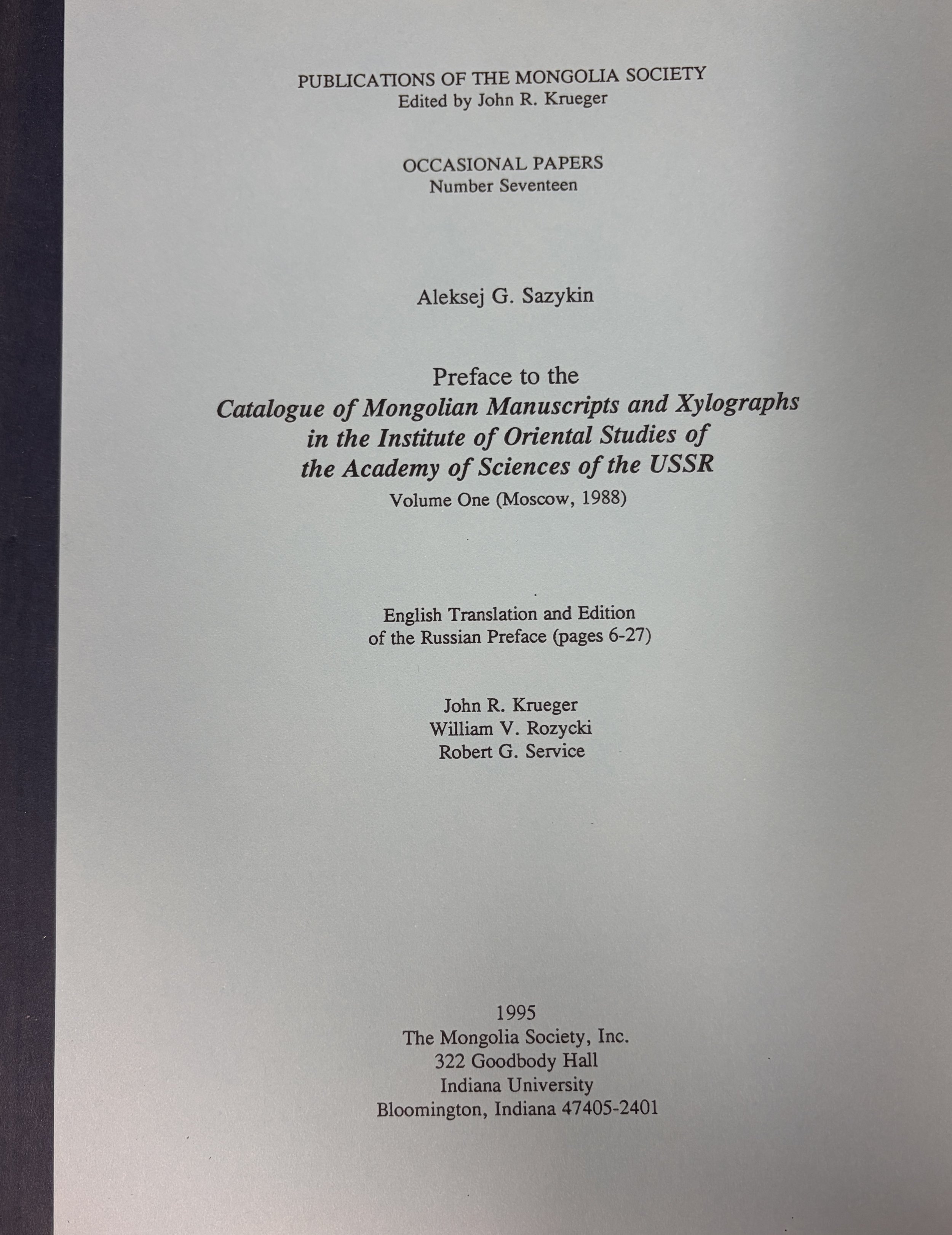
Occasional Paper Number Seventeen (Summer , 1995).
Aleksej G. Sazykin, Preface to the Catalogue of Mongolian Manuscripts and Xylographs in the Institute of Oriental Studies of the Academy of Sciences of the USSR.
English translation and edition of the Russian preface by John R. Krueger, William V. Rozycki, and Robert G. Service.
This Catalogue surveys the entire development of Mongolica in Russia. 30 pages.
$12.00
Occasional Paper Number Sixteen (Spring, 1995).
Mongol Oral Narratives: Gods, Tricksters, Heroes & Horses.
One hundred Mongolian folktales from Inner Mongolia. Topics include origins, monsters, lamas, humor, Gesar Khan, and fables.
Translated by Nassenbayer, et al .
Illustrated by Danzan, edited by Kevin Stuart.
83 pages.
$18.00
No results match your search. Try removing a few filters.